
 Charles Fitzpatrick, of Irish descent, was admitted to the bar, and inherited the desk, the same year his father-in-law died.


 In 1946 Corinne Kernan became Mrs. Pierre Sevigny. Sevigny was a famous Canadian war hero, who now became the new owner of the desk.
 1966 - The Munsinger Affair: Pierre Sevigny's name surfaced during the Gerda Munsinger scandal of 1966. He had long quit politics but his name was dropped in the Commons for an association - while he was a Government Defence Minister - with a German woman, who, at the same time, also had a relationship with a Communist East German military officer.




 |
Georgian 1820s Quebec Walnut (Caron/Fitzpatrick/Sevigny, Russell) Desk |
 Great Canadian Heritage Treasure Great Canadian Heritage Treasure |
 |
| Caron/Fitzpatrick/Sevigny/Russell Desk 1820s |
| Orig.walnut Georgian desk - Size - 36" x 50" x 30.5"h Found - Toronto, ON Provenance - Rene Caron, Sir Charles Fitzpatrick, Pierre Sevigny, John Russell |
| The desk is late Georgian or Regency period, made of walnut, and is made in three pieces for easy transportation: the top, and the two pedestals. The top three drawers go all the way to the back; the other six drawers are shallow to accommodate a cupboard section at the rear on each side, where probably liquor was kept at one time. The desk is finished with the same decorative detail all the way around so it could be used in the middle of a room and look attractive from all sides. |
Such a treasure is this desk.
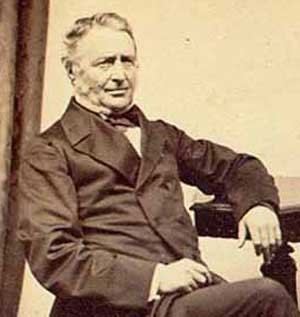
Hon. Rene Edouard Caron
1800-1876
 The desk was built in the 1820s for Rene Edouard Caron who was born at Sainte Anne de Beaupre, was admitted to the Bar in 1826 and became Mayor of Quebec in 1833, a job he held for almost 13 years.
He was also elected to the Legislative Assembly for Lower Canada in 1834, and also served in the Legislative Council at the Union of the two provinces in 1841.
He was voted in as Speaker of the House (of the United Canadas) three times, and also held a Cabinet post.
Together with Lafontaine, and Morin, he succeeded in getting "equal rights" for Canada East (Quebec), parallel to those awarded to Anglophone Canada West (Ontario).
Rene won acclaim not only for his patriotism, but for his disinterestedness, foregoing both personal honours and power, to better serve his province.
In 1853 he was appointed Judge of the Superior Court, and in 1855 of the Court of the Queen's Bench, an office which he discharged commendably for twenty years.
He took part in the codification of the civil laws of Quebec.
In 1872 his long career of unselfish devotion to his people and his province was crowned with his appointment to the Lieutenant-Governorship of the province of Quebec, a position which he held till his death in 1876.
 |
Rene Caron is shown, at centre, in 1859, with his colleagues, working on the Quebec Civil Code.
|
 |
 |
| The desk was in Rene Caron's possession through all the momentous years, before, during, and after the Rebellions of 1837 and the years of nation building that followed.
Mme. Josephine Caron: By his side, through it all, was Josephine Caron (below), much esteemed for her hospitality and benevolence to the poor. As Lord Mayoress of Quebec, in 1842, she was given the honour of opening the ball held by the Brigade of Guards in the Castle of St. Louis, to celebrate the birth of young Queen Victoria's son, the future King Edward VII. General Sir James Macdonnell, the Hero of Hougomont - at Waterloo - toasted her health, before a vast assembly. |
|

In her memory, an 1856 14" parian bust of Prince Albert - the happy father on that occasion - now graces the desk that was part of her life for over 50 years. (bust stamped WH Kerr & Co., signed RJ Jones, sculptor) |
 |
| Sir Adolphe Caron (1843 - 19-- : Rene Caron's son, Adolphe, played around this desk as a boy. He grew up to be a Canadian statesman in his own right, after attending McGill and Laval Universities.
As a lawyer he became an MP in 1873, and entered the John A Macdonald cabinet in 1880 as Minister of Defence and Militia. For his services in that post, during the Riel Rebellion in 1885, he was knighted by Queen Victoria. |
 |
Rene Caron was still using the desk at Spencer Wood, the Lieutenant-Governor's Residence at Sillery, when he died in 1876. His funeral was an immense public spectacle testifying to the enormous regard in which he was held in the hearts of Quebeckers. |
|
 |

|


|
René Edouard Caron - 1800-1876 |