


 |
Great Canadian Beaver, Eh! - 1800-2000 |
Itching for Beaver?
So you have developed a sudden passion for beaver! You are not alone...
At any one moment there is someone - apparently a lot more than one, across Canada - mulling over the possibility of buying a beaver they've taken a sudden fancy to. In fact the latest research suggests that beaver fever seems to be spreading across the nation.
We advise you to proceed with caution lest you waste your money by impulse buying a cheapie beaver which will leave you with nothing but eternal self-regret down the road.
We provide a few cautionaries to those contemplating going on a beaver hunt...
Inform yourself about the possible consequences of what you’re going after. Remember, there are as many myths about Canadian beaver (LAT. castor canadienne) as there are about Canada in general.
For example, it is commonly believed that Canadian beaver can only be found in wilderness areas, or wildlife preserves.
This is patently not true! In fact you can find castor canadienne in virtually any village, town, or city, across Canada. Most beaver hunters consider themselves fortunate that they are widely spread in most places, especially in the big cities.
In fact the hard truth is that you'll probably find the best beaver in downtown Toronto...
But not surprisingly it is also the most expensive there. Cheap beaver can be more easily had in Winnipeg, Regina, or Calgary, though in our experience, the quality there hardly warrants the expense of a trip. Unless you have better reasons for going there, like perhaps, to buy drugs, or maybe a watch from a street peddler, or to urinate in a park.
Wherever you finally do chose to shell out for beaver don't expect a bargain when making a deal. It has always been true, in Canadian history, that the best beaver commands the top dollar. This is still so today especially in the big cities.
So be prepared to pay; it is most inappropriate to be seen playing hardball in bargaining with a lady who is offering you a nice one for a fair price. Remember, the beaver seller has to make a living too.
Also, avoid going for a "cheapie" beaver as this often leads to not a little disappointment as well as being a waste of money. The old saw that "any old beaver will do" is not the best guideline to follow, at the best of times, unless, of course, you're really desperate...
Even then, we urge caution. We advise you to think of the consequences of a bad buy; why not wait for a better beaver. It may cost a bit more but it might be worth the wait. You may thank your lucky stars, down the road, for thinking twice before jumping in too fast on a beaver that is just not up to scratch....
Remember too, that living in Canada means you are never far from a beaver. So turning down a questionable bargain basement beaver today is no big loss; tomorrow you might find a high quality one you might like even better, and one laden with a lot less attendant self-regret.
In spite of what you may think initially, with experience you will discover that not all beaver is equally desirable. It is beginners, the uninitiated, who, because they are less discriminating, are more likely to come down with a bad case, of beaver fever.
So you should always resist any sudden urge, however strong, to leap in on all fours, as it were, if you spot a beaver which you've taken a sudden fancy to; impulse buying will certainly never get you the best beaver.
Instead, what often results, it that you may subsequently only be filled with self loathing, when you reach home and discover what you've really picked up, in a careless moment of wild abandon...
So if you find yourself coming down with a bad case, and you feel yourself overcome with a sudden urge to bag a beaver, we suggest, in future, you get a grip on yourself, instead.
Another myth that is commonly repeated is that castor canadienne is shy, and retiring.
Nothing could be further from the truth. Beaver can be readily had by anyone who knows the right place to look and uses the right technique to acquire this occasionally furtive prey for their private pleasure.
But you can waste a lot of time looking for beaver in the wrong places. After all they're small and hard to spot most days, and often discretely tucked away. So a direct, common sense approach is always preferred when on a beaver hunt.
What usually works best is just walking up to the counter and simply asking! "Madam, do you have a beaver I could look at?" usually gets quick results.
But be sure to ask politely or she may not be inclined to show it to you. In fact because I've been gracious, I've been privileged to see a wonderful assortment of beaver over the years, some of which I've collected, happily fondled for awhile, and then passed on to others so they could enjoy them too.
In fact, we are happy to report, sharing a beaver is an experience more and more people are pursuing with good results.
It is a fact, no matter how much you may like a beaver, initially, what you may find - the trend is definitely in this direction - is that you'll want to give it up, sooner or later, and let someone else get pleasure from it. Beaver, like so much else in life, ends up being passed around. Just like the old song says, "A woman goes from man to man, but a beaver goes from hand to hand."
Oddly enough, just as a wider assortment of beaver is becoming more readily accessible, than ever before, on the market place, there is a movement afoot to turn back the pages of history, by some, who contend that some beaver is more desirable than others. They seek to weed out the admittedly somewhat mutant sub genus castor canadienne easii in favour of an earlier strain which is looked on, in some quarters, as a much more preferable sub genus, castor canadienne semper decorum.
But it appears, according to the latest research, that this could be a losing cause.
Left, all found during a beaver hunt, of course...
 Great Canadian Heritage Treasure Great Canadian Heritage Treasure |
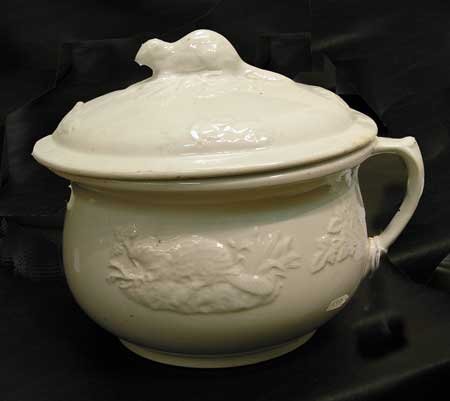
Oddly enough this beaver was found in downtown Toronto, reputed, by those who should know, as the place to find the best beaver in Canada. Considered by many in the trade as a thunder mug. Canada was built on the beaver - rather the chase after the beaver, with men traditionally sparing no time, money, or effort to bag as many as they possibly could. They were insatiable; no one seemingly, could ever get enough! Today, this part of Canada's heritage continues on without much apparent abatement in most parts of the country. |
 |
|
| Chamber Pot, c 1880 | |
| Orig. ceramic - Size - 31 cm Found - Toronto, ON |
 Honestly now, can you possibly imagine a nicer beaver sitting on top of this choice piece of historic Canadiana?
 | Great Canadian Heritage Treasure |
 |
Cast Iron Decoration, Ingersoll, Ontario, Canada, c 1875 |
Orig. iron - Size - 40 cm, wt 4kg Found - Simcoe, ON |
This magnificent painted and very heavy piece of 19th century metal Canadiana was probably a stove or heavy machinery decoration from the Noxon foundry and fabricating plant in Ingersoll, Ontario.
The Noxon family, descendants of United Empire Loyalist stock, started a foundry making stoves and plows in Ingersoll, in 1855. Within a few years Noxon Brothers Manufacturing Company - under James, Samuel, Stephen, Freeman, and Thomas Noxon - had buildings covering five acres that employed some 120 people, making the finest stoves, plows, mowers, power feed cutters, broadcast reapers, and cultivators money could buy. If a horse could pull it, the Noxons built it. Their Hoosier grain drill was the talk of the International Centennial Exhibition in Philadelphia in 1876. They used the best timber and the best iron to make the best machinery, turning out nothing cheap or frail. |
|


 The Walley service features an unappealing rodent squatting bloatedly on a maple tree branch, which, of course, never happened. Somebody forgot to tell the artists in England that beavers were not tree climbers like bears, or squirrels.
 You can easily find printed out keys for the early registration codes by Googling.

 Fine china, which was usually light in colour, thin, and so light in weight, often appeared translucent, was expensive, and was prized by discerning members of the gentile upper classes, like Lord and Lady Black, but not in places like the Silver Dollar Room of the Waverley Hotel in downtown Toronto, or in average homes, where the rowdy classes caused lots of breakage.

 Anyone who has experience stroking a Canadian beaver will tell you that they seldom bite; to the contrary, most seem to encourage you to keep on doing it, purring most appreciatively, provided, of course, that you approach it the right way. To be successful, the advance must be slow, careful, and, above all, sensitive. Else you might never get close. And even be snapped at... Obviously FT Thomas did not have the right technique...


