|
William Nicoll Cresswell 1818-1888 |
 Great Canadian Heritage Treasure Great Canadian Heritage Treasure |
 |
| Sailing Vessels, East Coast 1886 (detail) - William Nicoll Cresswell |
| Orig. watercolour - Size - 10" x 19 Found - Toronto, ON Signed, dated 1886 |
 The very essence of maritime life, along Canada's Atlantic coast in the 19th century, is captured with glorious elan, in a style which shows clearly why Cresswell became noted for his arresting seascapes: sails are flogging, conversation bounces back across the relative stillness of the water; as the men clunk their oars and jig for cod, a steamer rapidly approaches in the background. A hungry reef, marked by a line of swirling waves, seems to be beckoning, Come this way. The very essence of maritime life, along Canada's Atlantic coast in the 19th century, is captured with glorious elan, in a style which shows clearly why Cresswell became noted for his arresting seascapes: sails are flogging, conversation bounces back across the relative stillness of the water; as the men clunk their oars and jig for cod, a steamer rapidly approaches in the background. A hungry reef, marked by a line of swirling waves, seems to be beckoning, Come this way.
The tossing surf - probably from a rogue wave, from a passing steamer - breathes life into this scene and these men, recorded at Grand Manan, New Brunswick in 1886. Half the canvas is amazingly detailed rock; clearly, the Ontario farm boy in Cresswell is asking, What manner of men are these, to be able to wrest a living from such a harsh environment? |
Cresswell emigrated to Canada in 1848, and settled in Tuckersmith Township in Huron County, Ontario. He lived in relative isolation, in a rural location but influenced the careers of George Reid and Robert Gagen
Cresswell was a member of the Society of Canadian Artists, the Ontario Society of Artists, and a founding member of the Royal Canadian Academy.
Cresswell worked mainly in oil and watercolour and focused on animal, landscape, and marine subjects. He actually travelled extensively, to Georgian Bay in 1865, Quebec 1866, Lake Nipigon 1876, and the Gaspé and Maritimes in the 1880s.
In 1866 he married Elizabeth Thompson, at Clinton, Canada West. In 1876 he met and inspired a young local painter from nearby Wingham, George Agnew Reid. During his life he exhibited widely, in Canada, the US, and Britain, winning prizes and awards for his work.

| Great Canadian Heritage Treasure |
 |
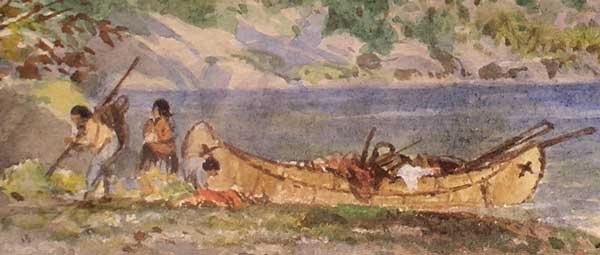
| Indians Coming Ashore 1877 - William Nicoll Cresswell |
| Orig. watercolour - Size - 5.75" x 8.75" Found - Toronto, ON Signed, dated 1877 |
A charming image snapped by the eye of William Cresswell, probably on Georgian Bay, captures so much detail that rings true for all those who have been there. An Indian man and woman have just come ashore, the man hunching over, caught at the moment he is laying down his burden. His wife watching, ready to see where she should start the fire for the meal. It has been a good day for paddling; the water is mirror calm, allowing the gulls to skim the surface to see if any fish are swimming just a tad too close to the surface. |
| Great Canadian Heritage Treasure |
|
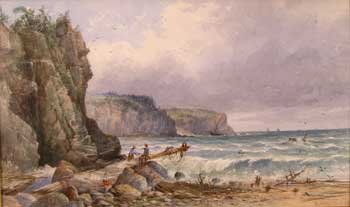
Shipwreck was, of course, a real life, almost daily occurrence, along the coast during the nineteenth century. In fact thousands of immigrants and fishermen lost their lives as ships foundered along cliffs and shallows in storms, or at night, in the days before warning beacons and lighthouses were set up to help ship captains avoid reefs and jutting headlands.
William Cresswell must have found the cold increasingly unbearable in the snow belt of Ontario. In 1887 he visited the southwestern US and decided to winter in California. Sadly, only a year later, on June 19, 1888, William Nicoll Cresswell died in his home "Cedar Creek" which he had built near Seaforth Ontario. A wandering soul, who had travelled widely to capture wonderful views of Canadian life for countless generations to come, lies buried in the heartland of the adopted nation which inspired him to create glorious images that will never die. |
|
| Shipwreck at Amethyst Cove, Grand Manan, NB 1881 (detail) - William Nicoll Cresswell | |
| Orig. watercolour - Size - 12" x 20" Found - Toronto, ON Signed, dated 1881 |
|
Two men, in avid conversation about the ship that broke up on the shore during the night, sit astride a massive main mast that broke off, to check if ropes can be salvaged. Cresswell skillfully tells a tale here: remnants of storm clouds are still scudding on, ships in the distance are warily passing by, spars are still floating in, and gulls are picking through the debris hoping something is left for them. We are left to wonder whatever happened to the people? In fact, untold thousands of European immigrants, hoping to find a better future for their families in Canada, found instead a miserable death along Canada's rocky shoreline. |