


 |
Joseph Julius Humme OSA (1825-1889) |
 Great Canadian Heritage Treasure Great Canadian Heritage Treasure |
It has arresting composition, with a masterfully executed dog group, centred out with a fortuitous stab of light, so instantly grabbing our attention in the foreground. Here Julius has given us individual dog portraits that show endearing personalities that any dog owner can only recall with a smile. |
 |
|
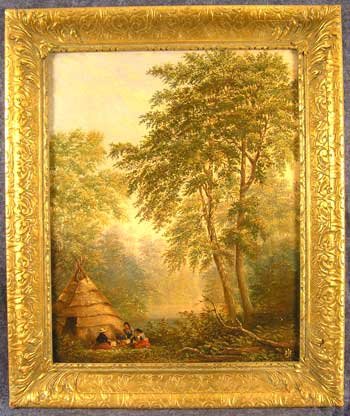
| Ojibway Winter Camp, Lake Couchiching, Ontario - Joseph Julius Humme OSA, c 1880 | |
| Orig. oil on canvas - Size - 42 x 60 cm Found - Toronto, ON Signed monogram JH |
|
After letting us savour the dog portraits, Julius leads our eye with an artist's S curve, and a middle ground dog, perhaps hoping for a morsel tossed his way, to the Indian group socializing in the background around a fire. Beside them, a rack keeps the food, or chewables, off the ground, away from gnawing critters. Our eye is then taken to a woman and her papoose about to enter a tent. Behind her is the icy surface of a narrow lake hemmed in by a forested shore and distant hills. The eye comes round the tents on the right and finishes off with satisfaction to dwell once more on the personalities waiting patiently in the foreground. As an ethnographic work its detail is perhaps not as rich as Armstrong and Verner at their best, but it is unsurpassed among painters of Canada's Indian peoples, in the human warmth the work exudes, what with each group in the community keeping their separate counsel while they endure the truly awful cold of a Canadian winter. |
|
 Vying with the best Indian works of Peter Rindisbacher (1820s), Frederick Verner (1890s), and William Armstrong (1890s), is this fabulous work of an Ojibway winter camp, masterfully captured, forever, by Julius Humme, probably on the shore of Lake Couchiching in central Ontario, at a time when Canada's First Peoples were still living in a traditional way.


 Members of the Chippewas of Rama First Nation are descendants of a larger Band known as the Chippewas of Lake Huron and Lake Simcoe. In October of 1818 the Chippewas surrendered a large tract of land south of Georgian Bay, and in 1830 they were settled by Sir John Colborne onto land between Coldwater and Lake Couchiching, the "Coldwater Tract."