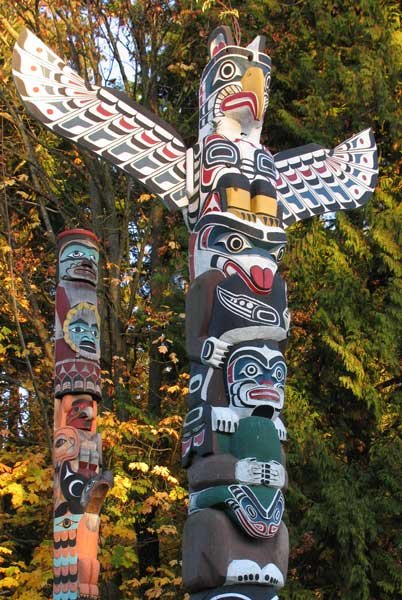
Ellen May Neel was born in Alert Bay, on Cormorant Island, off Vancouver Island's Inside Passage. Her father Charles Newman, was an American seaman; her mother Lucy, was Kwakwaka'wakw, the daughter of famous totem pole carver Charlie James.
Since her mother was sick so often she spent much of her childhood in Charlie James' care. From the age of ten on, she found him a stern taskmaster, making her repeat drawings over and over to get them right. She would often cry from the anguish of trying to please. By the age of 12 she was able to carve well enough that her totem poles sold to tourists who came to Alert Bay. She quit school at 18.
She took up with, and later married, Edward Lyle Neel, a smooth talking white salesman who had altered his name to escape a checkered past in the US, but his witty and facile tongue enthralled the local girls in Alert Bay. They thought he was a coveted catch, but the sheet metal salesman proved to be a marginal provider at best, especially for a family that grew to have six children.
In 1943 they all left Alert Bay and moved to Vancouver. In 1946 Ellen's husband had the first of a series of debilitating strokes that made him unable to work full time. The family was facing dire poverty.
Ellen decided she would have to become the primary bread winner with a sick husband, as well as six children to look after.
It was a Herculean task for anyone, let alone an Indian woman in Vancouver in the 1940s. What to do?
Ellen decided her only strength was her background in native art. Perhaps she and her family could make souvenir totem poles like she had with Charlie James years before in Alert Bay.
 Starting in 1946 Ellen recruited her family into making souvenir totem poles for the tourist trade in Vancouver. The city gave her a place in Stanley Park to set up shop during the summer. Commissions for larger poles sometimes came in. Today one stands at the University of British Columbia. Commissions for smaller presentation poles from one to two metres also dribbled in. But most of the output was the cheap smaller tourist poles (family stamped example here).
Ellen's talent and work had made her famous in Canada and overseas. But economic survival was always touch and go. On one occasion she had a commission for 5,000 poles from the Hudson's Bay Company but that was rare. Some months there were no sales for larger poles at all.
By 1960, when Ellen was only 44 the strain began to show as she suffered bouts of sickness where she could not work. In 1961 her eldest son Dave was killed in a car accident. She never got over the loss and sank further into depression.
In 1963, in the direst poverty, her friends told her to ask the Canada Council for help, and, in a refrain that has echoed down through the ages, assured her that the Council was always giving grants to all kinds of undeserving people for doing totally useless projects. Like maybe a suit made out of meat... Certainly they would help out the west coast's most famous Indian artist to assist her artistic development and keep Canada's first woman totem pole carver and her brood from going on welfare at the same time. The Canada Council, whose officers and offspring grew sleek and fat from salaries, expense accounts, and pensions, true to form, turned her down flat, though they expressed sympathy for her plight...
The brush off from the Canada Council hastened Ellen's decline. Her friends say when the letter arrived refusing help, Ellen just sat there, staring into space.
In the 1960s it was tough being an Indian woman trying to do the right thing in a society where special interests - read white men - ran everything for themselves and their kind. Is it any wonder that many people, and not only Indians, consider this snub a blatantly racist slight by Ottawa bureaucrats.
After that, things were desperate in the extreme for Ellen. With both parents sick and the children on their own, one brother stayed to keep Ellen and her husband from starving. He started selling off family heirlooms to bring in cash: Ellen's tools, her favourite Charlie James drawings and carvings, which she had kept for thirty years, and the family's sacred copper, mostly behind Ellen's back. When they found out, she and her siblings were furious but what could they do when you hit rock bottom. Ellen's depression reached new lows...
In January 1966, Ellen entered hospital for the last time. She died on February 3. She was only 49, totally worn out by the cares of life. An Indian woman, in the best traditions of her people, who had given her all to her husband, her family, the art of her people, leaving nothing for herself, not even her health...
She was betrayed by bad luck, but also by a society where artists, who are not tied in with special interests who pull the cultural money strings, doing their best is just not good enough, especially if you are Indian.




 Great Canadian Heritage Treasure
 A fabulous totem pole


 1975, over thirty years ago, when he was at his most powerful as an artist, and also, like Ellen Neel was, ten years earlier, in need of money.