




 |
Great Canadian Fake Victorian Paintings |
 Great Canadian Heritage Treasure Great Canadian Heritage Treasure |
Lighthouse by the Seashore
Acquired at a recent Toronto fine art auction, was the picture left, a pastel and watercolour painting advertised as "Lighthouse by the Seashore." Unfortunately, like so many old paintings one finds at auctions, this one was not signed or titled. The curator with no background - or less - in Canadian art or Canadian places - gave it a silly title. So you end up with what everybody hates at art auctions, an anonymous painting without a name or location. Lighthouses by the seashore were not popular at this auction. Probably somewhere in France, or the south coast of England most dealers thought. As a result it aroused no bidding interest... It happens hundreds of times at auctions every year. |
|
 |
||
| Lighthouse by the Seashore | ||
| Orig. pastel & wc on board - Image Size - 17 x 40 cm Found - Toronto, ON |
||
The painting has a wonderfully evocative mood created by a talented artist. It was probably painted in the late Victorian or Edwardian eras. But you think you recognize the place, and you buy it to check for sure... What do you do next. Find the lighthouse; find Henry, that's what!
|
||
Fake Curator - Some fakes are great! Below are some examples of Great Fakes, when an art curator - most are from Toronto fine art auctions where experts wear fine suits, evince the most perfumed airs, and the most haughty mien - just gets plainly bored by Canadian art and just gives it any old title. They much prefer paintings by the Group of Seven because they are usually identified so no research needs to be done. Just copy the name - voilà job done!
This is an opportunity for those who are interested in Canadiana to pick up Great Canadian Art cheap. But you have to know something, about art and your country's history and heritage, or you will be just like the hapless curators who threw all these on the trash heap of history...
| Great Canadian Heritage Treasure |
Fortress by the Sea Just another anonymous painting thrown on the trash heap of history by a leading Toronto fine art auction house, captioned with a mindless title by a curator who apparently has no knowledge or interest in Canadian historical art. The "Fortress by the Sea," is in fact, a view of one of Canada's very oldest forts, on the banks of the Richelieu River, Fort Chambly. The oil on board was painted and dated 1837 and signed by H. W. Cunleri, probably a British officer stationed there. The fort with its unique profile, was painted many times over the years, from this same spot, showing the same tree and distant hills. |
 |
|
| Fortress by the Sea | |
| Orig. oil on board - Image Size - 10 x 20 cm Found - Toronto, ON |
|

It shows how even at fine art auctions the experts are woefully lacking in knowledge, not only about Canada's historical art, but her historic places as well. Fort Chambly is a major Quebec tourist destination. She may not have seen the many historical paintings of this scene in countless books - OK we know people don't read books any more - but not ever having visited Chambly is unforgivable. Following a tone set by Canada's National Gallery, many fine art curators turn up their noses at Canadian art, preferring to go to Europe to see real art and real historic places. |
|
| Great Canadian Heritage Treasure |
A Fortified Town Another throwaway by a Toronto fine art auction house, whose curator called this A Fortified Town, probably more aptly describing the state she was in when she catalogued it, having no clue as to what it might be, or where... In fact it is a wonderful watercolour painted by R.B. Wood, dated 1830, of Montreal from Ile Ste.- Hélène The dead giveaway should have been the lumber raft, a sure Canadian clue, as is the York boat in the foreground. The soldier is on garrison duty at Ste. Helen's Island and the hill and town are similar to other paintings of the period done from this spot. From now on the painting will be much more desirable, and valuable, with its proper name: "Montreal, from Ste. Helen's Island, 1830, R.B. Wood." |
 |
|
| A Fortified Town | |
| Orig. wc - Image Size - 26 x 36cm Found - Toronto, ON |
|
Mystery at Ile Ste.- Hélène - A fascinating sidelight of this old watercolour is that it strongly mimics the Sproule/Bourne engraving of 1830. But in one significant way it is different. Whereas Bourne cheated, by depicting Notre Dame Cathedral, from plans he saw of the way it would look when completed with two towers, later, in the early 1840s, on this watercolour dated 1830, Notre Dame really looks like it was in 1830, with only one stumpy north tower that was under construction then. If this original watercolour was painted from the engraving, why select the church for such special attention, and bother to change its towers so drastically, and draw them accurate to the way they (one) really looked at the time? Who, indeed, would ever know, or care? |
|

| Great Canadian Heritage Treasure |
A French Farm Cast on the trash heap of history by a Toronto fine art auction with a throwaway title sure to arouse no bidding interest from anyone. Good for the smart buyer. It's not a French farm at all, but a Belgian one... La Haye Sainte farm, of course, is recognized by all those who paid attention in history class as the centre point of one of the greatest battles in history, the Battle of Waterloo, which brought down Napoleon, in Belgium in 1815, . The farm saw the dreadful slaughter during the high point of the battle as masses of French troops charged to dislodge the British and Prussians holding the farm. It is a watercolour painted, again, probably by a British officer revisiting the site a few years after the battle. The cannon ball holes in the house, and on the walls, should have been a dead giveaway but were missed by both the curator and bidders at the auction. Many British officers and men who fought at Waterloo later settled in Canada, and built the "Regency Cottages" that dot the southern Ontario landscape today. One of them brought this souvenir from the most momentous battle of the 19th century to Canada, and now, properly identified as "La Haye Saint Farm: Battle of Waterloo, 1815" will have a much more valuable provenance. |
 |
|
| A French Farm | |
| Orig. wc - Image Size - 24 x 27cm Found - Toronto, ON |
 A reverse angle view of the slaughter inside the farm in front of the house, looking towards the gate above.
La Haye Sainte farm was forward and central to the British lines at Waterloo. Wellington sent Major Baring and the King's German Legion to hold this key point on the battle front.
From 1 pm to 3 pm, the battle raged about the farm as the French tried to rush it to get at the main British lines behind it.
At 3 pm Napoleon ordered Marshall Ney to take the farm. A glorious charge by 8,000 cavalrymen failed as British reinforcements counterattacked.
At 5:30 Napoleon re-issued the order to take La Haye Sainte farm.
 Ney personally led an infantry regiment that launched a furious attack that swept over the farm whose defenders, who were now without ammunition, were largely slaughtered or in retreat.
At 7 pm, with the the farm neutralized, Marshal Ney ordered the Imperial Guard to pass the farm and engage the main British forces.
The climax of the battle ensued.
At 8:10 pm the attack faltered, with the French retreat gradually becoming a rout.
The cannon ball holes are still visible on the walls and side of the house.
The style of the figure is very much like those of James Cockburn in paintings of Canada he did in the 1830s.
For decades after Waterloo, former soldiers of Wellington's armies immigrated to Canada. One of those officers probably brought this souvenir of the war with him.


Today models of La Haye Sainte Farm (aerial above) are favourites of international militaria collectors and re-enactors.

Of the hundreds of men who originally defended La Hay Sainte Farm, only bare dozens survived and a few officers.
Today it is a private house with more than its fair share of tragic memories - every brick having been splattered with blood and gore from men at war...

| Great Canadian Heritage Treasure |
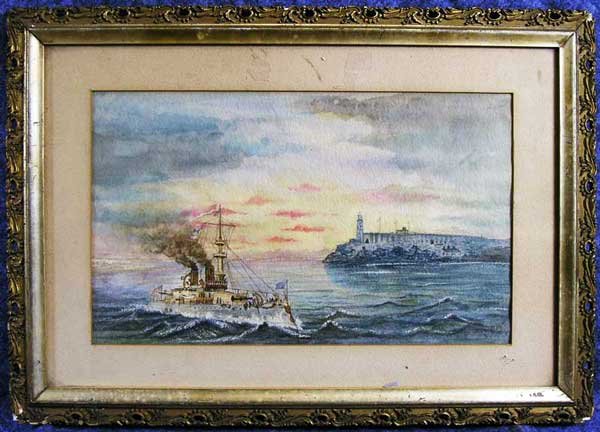
Alcatraz The high end Toronto auction house that sold off this original watercolour entitled it Alcatraz, all based on their art expert's research. Alcatraz is the historic prison island in San Francisco Bay. Which is why, when buying auction items, and even - especially - paintings from high end auction houses, you better know what you're buying yourself, before you throw good money after bad art...
There are, of course, many island headlands with lighthouses on them... Clearly the ship is the clue, not the island! This is obviously an American war ship of the Spanish-American War era. |
||
 |
|||
| Alcatraz | |||
| Orig. wc - Image Size - 26 x 44 cm Found - Toronto, ON |
|||
|
|||
Copyright Goldi Productions Ltd. 1996-1999-2005 |
| Great Canadian Heritage Treasure |
An Unknown Gentleman A truly fabulous large and ultra rare piece of historical art. But who is it? It turned up at a high end Toronto fine art auction dismissed by the art expert merely as an "unknown man." It came from a Rhode Island estate. The frame is fitted around an oil painting on a wooden slab which is heavily lacquered and framed with sea shells, two of which have fallen off, and two are damaged. But then the piece is ancient, well over 100 years old. The portrait has a split behind the ear caused by the wood drying out through time. We originally thought it Spanish-American War (1898) in origin, but the age burn throughout, is considerably older than that... The portrait is obviously of an American officer, wearing a uniform - epaulettes, collar, and buttons as worn by naval and army officers from the Civil War 1861 to around 1910. The sash is noteworthy and should be a defining clue as to the man's identity.
|
|
 |
||
| An Unknown Gentleman | ||
| Orig. oil on wood- Image Size - 49 x 47 cm Found - Toronto, ON |