 Great Canadian Heritage Treasure Great Canadian Heritage Treasure |
|
|
Petocahhanawawin - Poundmaker
Edmund Morris 1910 |
Orig. pastel - Size - 39 x 54 cm
Found - Toronto, ON
Pastel on paper, and signed by Edmund Morris |
|
Once the treaties were signed the land was surveyed, divided up among the white settlers that flooded in, and all the land deeds kept in stone vaults in the brick building above, specially constructed for the purpose.
Unrest began because the Government officials were poor at keeping their word, and coming up with the deliverables they had promised, in the treaties, to provide in a timely fashion: food, money, and implements.
In the meantime, in exchange for staying put on very small reserves, Indian men watched their wives and children starving, as treaty rations and payments, they had counted on, were not forthcoming.
Who was to blame for the troubles to come? Locals? Hired contractors? Or bureaucrats in Ottawa? Does it really matter when people are starving?
Only one thing was certain, it was white men behind it all, and their symbols of aggressive and ruthless domination of the Aboriginal people were all around.
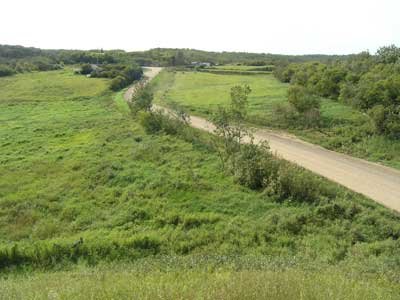 In the Battleford area a key personality was Cree Chief Poundmaker, whose people were confined, these days, to a tiny reserve west of Battleford. He decided to march with members of his band to Fort Battleford to meet with the Indian agent there and plead the cause for his starving people.
When the folks at Battleford heard the Indians were coming, they fled from the townsite - which once spread on both sides of the road right looking west - to the safety of the Fort which was across the Battle River - the treed banks right - and up the hill on the other side.
When Poundmaker could get no one in authority to deal with his pleas for help for his starving people, he lost control of his young men.
Poundmaker who was a respected chief among his people now became a victim of a situation that was far beyond his control. The whites had made him look ineffectual and weak, and an object of derision, in the eyes of the young warriors. They began to break into houses along the street right, looking for food, and alcohol. Looting began; a fire broke out here and there.

Left is all that remains of the road foreground that once led to the bridge over which the panic-stricken whites fled across to the north shore of the Battle River, and up the hill to the fort beyond.
A special focus for Indian anger was the land registry office which was located on the hill, among the trees, on the far left end of the road, above. (Taken from the bridge left).
Local lore holds that the holes in the wall below were made by angry Indians trying to get at a building which housed the documents which were the source of all their troubles.
The "Burning of Battleford" was wildly publicized across Canada. The feeling was general that "our Indians are just as bad as theirs;" meaning the Americans. It had only been 9 years since General Custer and his command had been wiped out at the Battle of the Little Big Horn, just across the border. Were "our Indians" going to do that to us?
 Among whites, sheltering inside Fort Battleford, fear of Indians was as real as it was unjustified. In spite of repeated, and severe provocation, virtually all Indians, at all times, were loyal, always wanted to be loyal, to the Crown. And trusting...
But that didn't matter in Ontario, where white militiamen were eagerly sharpening their swords and bayonets, ready to put the red man in his place.
Scenes like that painted below for the Canadian Illustrated News only fueled the fires of intemperance and revenge among young white men who were eager for "blood sports."
The citizens fled across a bridge that stood where the railway bridge is at the far right.
They were heading for the fort which is on the skyline above the middle of the barn. Bridges mark the Battle River.
The land registry office is located some 100 yards behind the camera.
The town was never rebuilt on its old site, here, but expanded instead, beyond the Fort, on the other side of the North Saskatchewan River which flows in the valley beyond.

The good citizens of Battleford wanted to get as many rivers between themselves and the Poundmaker Reserve as they could - two, the mighty North Saskatchewan - just over the ridge on the horizon above - and the Battle River, bridges above.
Beyond is the junction where the Battle River - treelined shore on the left - joins up with the North Saskatchewan River.
The large hole in the foreground is part of the trench system built by Colonel William Otter left when his Toronto militiamen arrived to defend the fort. They dug in along the brow of the hill, looking toward the ashes of old Battleford, just beyond the tree lined Battle River.




 An important Canadian heritage treasure in desperate need of some of that money being blown up, by our military adventurers, in Afghanistan.


