 |
Royal Ontario Museum - George E Laidlaw Coll |
 Great Canadian Heritage Treasure Great Canadian Heritage Treasure |
We are always sleuthing out high profile antique shows. Especially those with a reputation for high prices, because antique dealers try to save up special items to sell for large amounts. The logic, for us, is that unique items will show up there that are set aside from ordinary auctions. That is also why we make sure we are first in the door, on opening night, before the crush of greedy buyers overwhelm the place, and clean out the choice items. The door had hardly been open for five minutes when we spotted this large oil of an anonymous soldier, by an anonymous painter, in the booth of a seller who knew next to nothing about the picture, or the era, the sitter was probably from. The crowd was gathering and we knew if we looked further, to see what else was available, it would probably be gone, sold to a knowledgeable collector, or, a smart dealer, looking for choice items he could "flip" at inflated prices at another sale. Believing we had a special item, of exactly the kind we were looking for, we asked for "her best price" for an item that was already priced very low. Sellers know that paintings of anonymous sitters by anonymous painters are not popular among antique buyers. So was he English, Hungarian, Austrian, French, Italian, Polish, Spanish, or German? All possibilities, in Canada today, where antique portraits have been brought over by generations of immigrants from all parts of Europe over the last hundred years. |
 |
|
| Lt. George E Laidlaw 1885 | |
| Orig. oil on canvas - Size - 16" x 24" Found - Bowmanville, ON Unsigned, pencil dated c 1890 |
| theCanadaSite.com |
| Copyright Goldi Productions Ltd. - 1996, 1999, 2005 |
Copyright Goldi Productions Ltd. 1996-1999-2005 |
The George E Laidlaw Collection - The Royal Ontario Museum
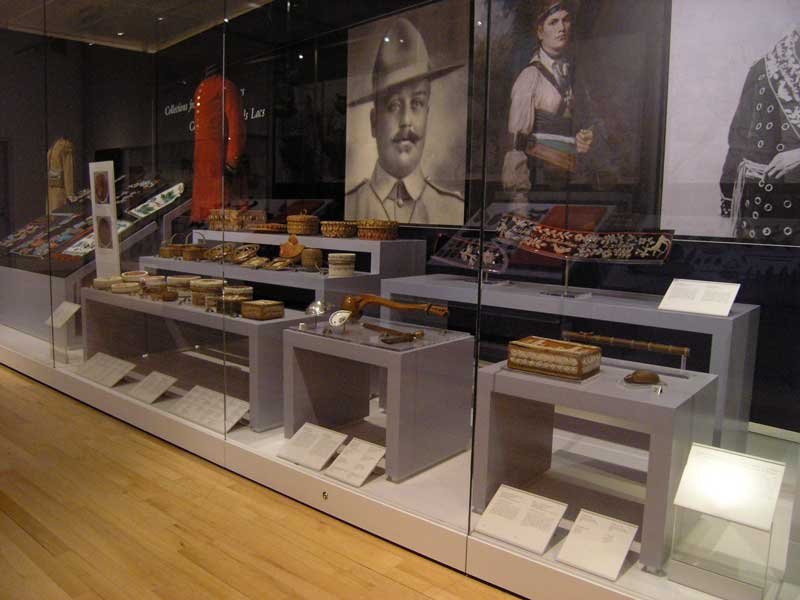
 George E Laidlaw (1860-1927) of Linday Ontario, a Royal Military College gradutate, a veteran of the Riel Rebellion and the Boer War, went on to play an important role in investigating and preserving the artifacts and cultural lore connected to the Aboriginal People of Ontario's Victoria County.
There is a large display above of Aboriginal items from his collection at the Royal Ontario Museum, in Toronto, Ontario.

Unfortunately the signage for his fine collection is abominably placed, near the floor, where you have to literally get on your knees to be able to read the small type in the dimly lit display. (Left the light levels as they are; we boosted the exposure on the larger picture for this page.)
None of the many people we watched go by, on a Sunday afternoon, even tried to strain their backs, knees, or eyes to make out what the signs said.

Heck, none of the staff members read them either, or they would have discovered what happens in every case - as you lean forward, to get close enough to be able to read the small type, you always end up throwing a heavy shadow over an already dimly lit sign, adding further eye strain.
Being more dedicated than most, we knelt on hard flooring - as former Catholics we're used to pain from kneeling - and twisted our eyes in knots to make out the small script. But eye strain and headaches soon stopped even our intrepid efforts cold. And we just peered at things... in utter frustration, in the gloom...
The result, of course, is an educational experience somewhat similar to a deaf husband listening to his wife, watching a slide show with no sound, a TV with no audio, or a preacher with no sermon - you haven't got a clue what it is you're watching. And no one ever becomes the wiser about who collected these priceless artifacts, or what it says about Canada's Aboriginal Peoples, or Canada's heritage or history.
So what's the point? George's contribution is lost to most visitors...
Educationally, intellectually, this museum experience is a total bust...
So the museum is reduced to basically being there only to provide jobs for employees... to do bad displays...
Other exhibits in this large room were also abysmally lit and plaqued, so badly that we told ourselves the next time we come we'll bring knee pads and our own flashlight. Seriously... we will.
Knee pain and eye strain interfere with learning, on every level. And the old saw about low light levels to protect the artifacts is ludicrous. Automatic switching of light levels is cheap and easy to do and a clear requirement for proper public viewing, appreciation, and learning. Otherwise simply close the place up and store the few items on display in the basement, where the overwhelming number of museum artifacts are already.
Someday, we hope, George's collection will get proper signage, when the ROM gets curators that know something about public education, visual learning and exhibit presentation.
The Royal Ontario Museum - Then and Now

Below a young couple gaze at the ugly and cheap looking old part of the Royal Ontario Museum, glad that the Museum director, William Thorsell, has a promising new vision for an improvement. And not a moment too soon either...


The Royal Ontario Museum, you may recall, won great notoriety, when, instead of choosing to improve obviously inferior displays for its existing collections, it decided, instead, to spend multimillions on a reno project for a new wing in the SAWIWFF style, dear to the heart of its artistic promoter, William Thorsell.
(SAWIWFF - Screwed Angular Wallboard in Washroom Fluorescent Finish - also known as Willie's Wallboard Heaven or Walmart Style, because apparently the architect was artistically inspired after visiting a Wal-Mart store.)
Below the ROM store. You Wal-Mart shoppers will note the astonishing similarities...

You can see by the great artistic transformation from the old to the new, with one of the exquisitely finished banisters above, how the whole place has been screwed up... with Willie's wallboard, that is...
The amount of screwing involved is truly mind-boggling, as there are literally millions and millions of exposed screws everywhere, holding jagged sections of wallboard together... And all on full display, on ceilings, and walls, to impress visitors that the architect spent his millions on screwing... and not himself...
The craftsmanship is most sublime,
With every angle match... divine...
Most visitors uncharitably voted for the SAWIWFF reno as the Toronto building mostly likely to be demolished in the next ten years. That would make it - without peer - as the most expensive piece of trash ever produced in Toronto's entire history.
This is, of course, an unkind assessment, totally lacking in insight, vision, or artistic or architectural appreciation...
 With its intimate ambiance, soft and soothing lighting, colourful decor, creatively designed counters, and artistically arranged displays, Willie's Wallboard Heaven is a shoo-in to become the next Wal-Mart outlet at the prestigious address at Bloor and Avenue Road.
Apparently Wal-Mart executives were beside themselves when they discovered the building, amid reports it might be up for sale. Could a ready-made flagship store be far away?
Giddy with excitement, enthused its board: "Goodness, and we don't have to change a single thing to fit in perfectly with the rest of our chain. Why the bookstore counter offers just the perfect ambience for displaying cartons of toilet paper and feminine hygiene products."
Below the stunning new entrance to Willie's Wallboard Heaven.
Wallboard here, and wallboard there...
Wallboard screwed up everywhere...


Left a disappointed customer ducks around the creative new pylons that support the reno, wondering why the pictures, that she expected to see displayed in a museum, weren't hanging on them...?
She was further miffed, to have had to pay an inflated entrance fee - to help pay the architect for his expensive reno - and discover that so little was on display, besides the divider poles in the hall...
She was assured, by staff, that the exhibits she had expected to see were well taken care of, in the basement, and would be displayed as soon as the staff could figure out how to hang stuff on all the crooked surfaces, and how to put display cabinets against angled walls and pillars.
They said it may take a few years to figure out...
Because the pillars are slanted at such terrifying angles the ROM makes it mandatory for visitors to wear hard hats, to prevent head injuries from accidental contact with the sharp edges.

These columns, again, are tastefully covered with wallboard, artistically screwed into place.
Left to make sure that none of the multimillions of dollars in materials used to build the reno, went to waste, all the left over bits - lights, pipes, glass, columns, and jagged chunks of wallboard, were temporarily - OK, we admit, it, carelessly - stacked up in a corner, till someone could figure out a use for them...
A wall bent here, a wall tilt there,
There isn't a straight wall anywhere...
The ROM reflects our moral core,
There's nobody straight in TO no more...
 Go to J Heath, You, not the ROM got it right... Go to J Heath, You, not the ROM got it right... |

