


 Great Canadian Heritage Treasure Great Canadian Heritage Treasure |
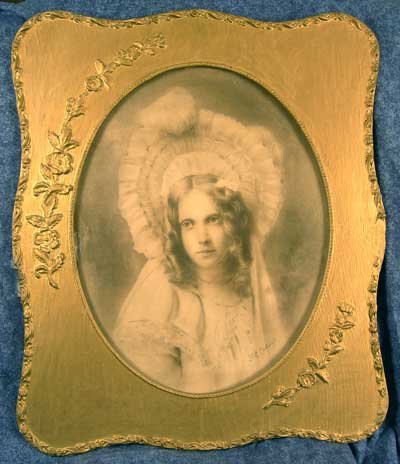 |
Girl in Bonnet, Fanny Colwill Calvert c 1905 |
Orig. charcoal - Size - 15" x 19" oval Found - Toronto, ON Orig. frame & glass |
 Who has ever drawn a more hauntingly beautiful portrait of a young Edwardian girl, just about to go out to the park for a Sunday afternoon stroll, near the village bandstand. Fanny has framed an innocent face, tinged with sadness, with glowing coils of delicate soft hair. If eyes are the windows of the soul these are as wonderful examples of inner light as you will find. It is a study that the master of portraiture, Suzor-Coté, would be proud to call his own. Who has ever drawn a more hauntingly beautiful portrait of a young Edwardian girl, just about to go out to the park for a Sunday afternoon stroll, near the village bandstand. Fanny has framed an innocent face, tinged with sadness, with glowing coils of delicate soft hair. If eyes are the windows of the soul these are as wonderful examples of inner light as you will find. It is a study that the master of portraiture, Suzor-Coté, would be proud to call his own. |


| Great Canadian Heritage Treasure |
 |
Lost in Thought (detail), Fanny Colwill Calvert c 1905 |
Orig. pastel - Size - 18" x 24" Found - Toronto, ON |
| An achingly sad portrait of a girl lost deep in thought - thought that must be painful. Fanny has produced a moving portrait that makes one wonder what private torments curl those lips, lift that brow, but above all torture those eyes so deeply. Was Fanny thinking of the private demons that troubled her own life for so many years? |
In Victorian Wales, Fanny’s mother had forbidden her to marry her first love, so she wed instead, her first cousin, a sea captain. Unfortunately, he drowned a few years later, leaving her alone to raise three small children, Will, Fanny, and Tom. She inherited some buildings and ran a “Young Ladies school” for a time. But Fanny Colwill was a powerful personality who dreamed of far better things for her children than life in dreary Dickensian England could offer.
Enthusiastic letters from friends who had migrated to Hamilton, Ontario, tweaked Fanny’s interest in Canada. Ever the decisive one, who knew her own mind, and never shirked from sharing it, Fanny took her family to Canada in 1890, believing her children would have a better future there.
Aboard ship a suitor, Herbert Calvert, became attracted to Fanny’s daughter, but soon transferred his affection to her magnetic mother. He asked Fanny’s son Will, permission to marry his mother, since especially the spurned daughter, was most hostile to the idea of this match. To no avail. In 1891, the 28 year old Herbert married the 42 year old mother in Hamilton. They all moved into the same house together...
Fanny Colwill Calvert's Pride & Joy: No it was not her art, or her husband; it was her son Will. He carried her own artistic genes and she pushed him incessantly to better himself so that he could take full advantage, in his adopted country, of his artistic talents and set himself up in a design and architecture business.
After developing his skills by working in design firms in Toronto, Will returned to Guelph, where, with his brother Tom, he set himself up as W. Frye Colwill, a firm specializing in architectural design, engineering, and construction.
Fanny was immensely proud. After all that she had gambled for her family she worked hard to make sure her strenuous efforts did not go to waste. She even upbraided Will severely - he was in his late 20s now - for pursuing a relationship with a lower class dressmaker who, she reminded him brusquely, was hardly the kind of woman to be seen as an asset for the town's leading architect.
Fanny also worked in his business office organizing the company's accounts and even helping with the design work.
Perhaps it was also to keep an eye on Will? Though she suspected the worst - at times - she did not know that Will had gone underground with his relationship.
 Fanny the Sculptor: One of the contracts Will's firm got was to carry out the decorative work on a new Galt Carnegie Library (left). It was Fanny Calvert herself, who spent several months in Will's stone works patiently carving the Ionic capitals that were to sit on top of the columns over the entrance way.
Fanny the Painter: Because Fanny was such a driven and assertive personality, her household was often in turmoil. Yet all were drawn to her for various reasons - none could live without the focus she brought to their lives.
Her faithless husband relied on her for money to bail him out. And Will, for all her interference in his personal life, doted on her, relied on her constantly.
Great Canadian Heritage Treasures |
|||||||||||
|
|||||||||||

 Many small Ontario towns feature a Carnegie Library; few people know how, when, and why, they came to be there.


 It would take four years of controversies with the various contractors, and the Carnegie donors, before the library was ready in 1905 (left and below.)
 The Carnegies thought that too much money was spent on the outside - what the architect wanted people to see - instead of the inside - what was offered to the users.
 Will was involved in other libraries as well. His was the winning design for the library at Palmerston, Ontario, (left & below), another project which really irked the Carnegie people.
 They had approved a proposal for a library there - without seeing the plan - and sent the grant. When Palmerston subsequently asked for a further grant for expansion, the Carnegies were dismayed to discover that Palmerston had used their library money to set up a municipal building, of which the library was only a small part.
 The grant was angrily refused; subsequently the Carnegies demanded that a picture, and detailed plans, of the proposed building be included with grant requests.
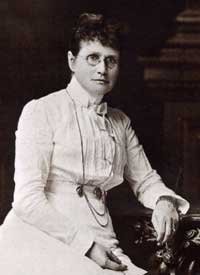 Fanny's Diary - Fanny wrote a detailed diary in which she recorded all her experiences in Guelph during this period. "The Diary of Fanny Colwill Calvert: Portrait of an Artist 1848-1936" was privately published by Marian Frye Colwill-Maddock in 1981. It covers the turbulent years of her life from 1890-1910, part of a record of her daily life she kept till she died.
“Will insisted today that I should go over in his office and work at my painting, he says my studio is too cold, so he carried over my easel.”
Probably her preaching to Will, about bettering himself, had struck a cord within her. In the late 1890s she had started to take painting lessons herself. Was this another way to find calm amid the turmoil in her family? Her unreliable, and unfaithful husband finally abandoned the family, and Guelph, and returned to England in 1904.
Fanny threw herself into her art, and was soon exhibiting her work at fairs and winning prizes wherever she did. Clearly, Fanny Colwill Calvert was a natural born painter. But she also knitted, tatted, carved and made wood burning plaques (pyrography).
