|
 |
|
|||||||||

 Great Canadian Heritage Treasure Great Canadian Heritage Treasure |
 |
Exploring the Unknown, Champlain on the Upper Ottawa, 1613 - JD Kelly |
Orig. print - Size - 41 x 51 cm Found - Toronto, ON Framed, on the back of the original sketch JD Kelly drew of this scene |
| Simply Fabulous! By hitting the roll over you can compare the finished litho above, with the original design sketch JD Kelly drew, and see the changes a creative artist makes as he progresses from idea, through sketches, proofs, to the final published lithograph. Because several detailed sketches were usually needed, most were never fully painted, or even sketched in, like faces of background figures. This fine sketch in the roll over, which has been completed in great detail, is probably JD's last one before he executed the master that became the final published litho above. |
| Great Canadian Heritage Treasure |
 Canada's First Wheat Canada's First Wheat
An original personal proof of JD Kelly's shows how the final colour scheme looked. JD Kelly depicts what clearly must have been an emotional scene - like when Peter Fonda scattered a few seeds in Easy Rider - real seeds - and solemnly, to the sceptics assembled, intoned "They'll grow!" But with the priest kneeling, the early Catholic settlers were not about to take any chances. This is not at all a hokey addition by JD, as some modern sceptics might scoff. Even in the 21st century priests visit farms in Quebec to bless the fields so that crops will be bountiful. JD successfully conveys the emotional feeling that planting seed is an extremely special moment in time, and to those who have done it - farmers included - it most certainly is. Human emotion, of course, is one feeling that the painters of the merely pretty - like the Group of Seven - never captured in any of their work. |
 |
|
Sowing the First Wheat in Canada - JD Kelly |
|
Orig. personal artist's proof - Size - 36 x 46 cm Found - Brampton, ON Titled in JD Kelly's hand, Prov - JD Kelly friend collection |
|
 Simply Fabulous! JD's annotations of his personal artist's proofs provides a wonderful personal link to one of Canada's very finest painters. Both these notations are on the border of the above proof. They also allow us to verify that the writing is his by similarities and curiosities of style, such as his penchant for often using printed capitals to start written words, and ending phrases, words, and titles with periods (here and below). Simply Fabulous! JD's annotations of his personal artist's proofs provides a wonderful personal link to one of Canada's very finest painters. Both these notations are on the border of the above proof. They also allow us to verify that the writing is his by similarities and curiosities of style, such as his penchant for often using printed capitals to start written words, and ending phrases, words, and titles with periods (here and below). |
| Great Canadian Heritage Treasure |
Canada's First Wheat
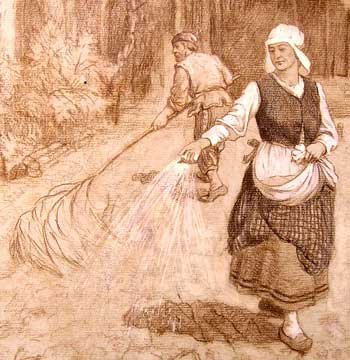
Louis Hébert is considered the first Canadian farmer; his wife Marie Rollet, the first farmer's wife; his son-in-law, Guillaume Couillard, the first farm hand. Firsts like this are very important to establish; it gives teachers something to give to students to memorize for exams. Hébert had made early attempts at farming in Acadia (Nova Scotia) at Port Royal, then returned to France. Champlain convinced him to return to Quebec. So he came in 1617 and got a land grant in Upper Town in 1623. Growing crops was a daunting challenge in a climate where winters were long and hard, and the land covered everywhere, with trees. JD gives a good idea of how it must have looked after a small patch of ground was cleared and dug up, ready for planting. Presumably Marie, scatters seeds from her shawl while Louis uses a branch to drag dirt over them to protect them from birds and give them better rooting possibilities. |
 |
|
Sowing the First Wheat in Canada, Quebec 1619 - JD Kelly |
|
Orig. gouache wc - Size - 61 x 76 cm Found - Brampton, ON Annotated and initialed in JD Kelly's hand, Prov - JD Kelly friend collection |
|
He may have done this when he was retired, and sorting through his art materials, noting special achievements for some of his creations. Proudly he adds that this watercolour finally appeared in a calendar by the Bank of Commerce. |
| Great Canadian Heritage Treasure |
Canada's First Wheat
Not all JD Kelly's personal proofs were in colour or lithographs. This one was a photographic copy of a sketch he completed in black and white. In other files he notes that photos of other proofs existed. Photos allowed him to make exact copies of sketches to hand out to contracting clients who could point out exactly what they liked or did not. He could also match the sketch more easily to the final art work. Nevertheless he titled this photo print in his own hand writing that it was of his "first design." Comparing it to the first original gouache above top we can identify that it was, in fact, the "First Design" - the actual original art - that JD painted for a picture that became widely celebrated on calendars put up in offices and garages all over Canada. |
 |
|
Sowing the First Wheat in Canada - JD Kelly |
|
Orig. personal artist's proof - Size - 38 x 48 cm Found - Brampton, ON Titled and annotated in JD Kelly's hand, Prov - JD Kelly friend collection |
|
 Simply Fabulous! JD's notations on a photo of his original art work makes it very clear that what went on in JD's head was the most important design phase of all. It shows the enormous wealth of information JD must have accumulated from his research to plan the setting, the types and number of figures, their dress and activities, which found expression in his "First Design" gouache top. The remarkable thing is how close the original sketch was to the final published print. It shows the respect that JD's clients had for his power as a historical artist, that the only changes made were artistic, meaning they all came from JD himself. Simply Fabulous! JD's notations on a photo of his original art work makes it very clear that what went on in JD's head was the most important design phase of all. It shows the enormous wealth of information JD must have accumulated from his research to plan the setting, the types and number of figures, their dress and activities, which found expression in his "First Design" gouache top. The remarkable thing is how close the original sketch was to the final published print. It shows the respect that JD's clients had for his power as a historical artist, that the only changes made were artistic, meaning they all came from JD himself.
Below you can see how JD changed his original in the final artist's proof. |
 |
 |
| Above, the man's cap has become a slouch hat, his beard grown substantially, and he crouches more. The improvised rake has been made rougher - and more effective - than the wispish original. The woman's dress has lost the print but gained a border, and the shawl significant weight and bunching of material. In the background the logs have become a more realistic stump and some people have been added. | Below, the priest, who seems to be sitting down on the job in the original, is definitely properly kneeling in prayer in the final, gained some hair, and more of a beard too. The Indian has let down his hair, the courtier is more formal, and the big-headed baby has been properly proportioned. Watching it all is what looks like Champlain himself, though the woman beside him does not look like the 12 year old he was courting at the time. |
 |
 |
Louis Hébert's original farm is now covered by the Basilica - home of the oldest parish in North America - standing on top of the hill just above where Champlain had his Habitation by the water's edge. Here Champlain came to marvel at the lush crops of grain and vegetables that Louis Hébert had planted all entirely by digging with hand tools without even a plow to work the ground.
In those days, the plot of land would have been very small, surrounded by big trees, much as JD pictured it, right. As a professional apothecary, Louis had more than a scientific interest in growing a variety of plants, some of which he could use medicinally. Various Indian tribes, had, of course, been planting squashes and maize in various places across America for their subsistence way of life. But if one had to pick names, and a place, in which to root the beginning of cash crop farming in Canada, who is more deserving of the honour than Louis Hébert (1575-1627), his wife, Marie Rollet (1580-1647), and their son-in-law, Guillaume Couillard (1613-1663) and their pioneering farm, now part of the sacred grounds of the Basilica above. Somewhere too, on this small patch of ground, Champlain, is buried. Archaeologists continue to probe under the foundations of buildings beside the basilica but the Father of New France proves as elusive as ever. Right a fabulous calendar, popularizing the history of Canada through the art work - entitled "A Pioneer of Canadian Wheat Farming" - of a fine painter, in a form that brought Great Canadian Achievements before the eyes of millions of Canadians. |
|||||
| theCanadaSite.com |
| Copyright Goldi Productions Ltd. - 1996, 1999, 2005 |


 Simply Fabulous! JD wrote on the matte of this outstanding watercolour, referring to himself in the third person, and writing his name in long-hand for those, in future years, who might not know who JDK was. In fact on almost all his working materials JD wrote some titles, or comments, so that the significance was not lost to history should the uniformed ever come into possession of his precious art.

