Louis-Philippe was one of 13 children, born in 1850, into a very poor Acadian family who lived in a one room log cabin.
Sometime in his teen years he wondered if the life of a struggling farmer was for him.
Catholic service was a common sentiment that was ingrained in Catholic families in those days; so a daughter might go into a convent, a son become a priest.
Louis-Philippe thought he would become a Papal Zouave, instead. Garibaldi, the Lion of Caprera, had raised an army of democrats who wanted to unite all the principalities into which Italy was fragmented under one king. In the wave of nationalism which was sweeping through Europe, many Italians thought they should live together in one country.
One opponent, who disagreed, was the Pope, who preferred to be an independent Prince in his own duchy.
When Garibaldi started his march upon Rome the call went out for Catholic boys to come help the Pope's armies to resist the heathen hordes of Garibaldi's godless mob.
In far-off Canada young Louis-Philippe decided he would help, and went to Italy and joined the Papal Zouaves.
In the end Italy was unified, but an agreement was made to leave the Pope independent inside the Vatican. Louis-Philippe went home.
But he was a changed man. Inside St. Peter's he had seen marvellous statues such as he had never believed existed. He determined to become a sculptor too.
Back in Quebec he apprenticed under Napoleon Bourassa, working on religious commissions for churches, often in wood and terra cotta. Between 1879 to 1887 he created over 60 interior sculptures for Ottawa's Notre Dame Cathedral.
In Ottawa he won a competition with 17 artists to complete the first monument - that of Sir Georges Etiènne Cartier - for the new Parliament Buildings.
In the early 1890s he got the job of creating figures for the facade of Quebec's National Assembly.
He won other commissions for Parliament Hill. In 1893 his submission for a monument to Sir John A Macdonald, won out, over 54 others, from artists in several countries
His subsequent submission for Alexander Mackenzie won too, but the committee considered it a tie with Hamilton MacCarthy so they collaborated to finish the monument.
 |
Louis-Philippe Hébert 1 - 1850-1917 |
1 |
2 |
3 |
4 |
5 |
6 |

All the busts and statues we've seen, are always signed Philippe Hébert or P. Hébert - never Louis-Philippe Hébert. And unlike the stamped signatures, one so commonly encounters, "Philippe Hébert 1889" was personally inscribed, on the wet clay, by the very hand of Philippe above.
As Premier of Nova Scotia, from 1864-1867, Sir Charles had been one of the original Fathers of Confederation, taking part in all the conferences that hammered out the founding Constitution of the Dominion of Canada, in 1867.
 Great Canadian Heritage Treasure Great Canadian Heritage Treasure |
|
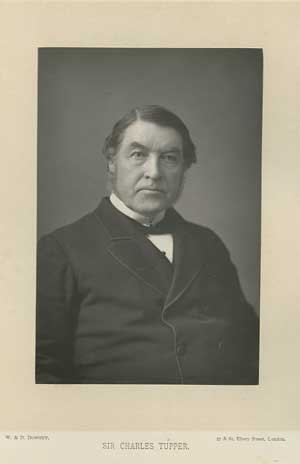
Sir Charles Tupper, W&D Downey, c 1888 |
Orig. photo - Size - 10 x 13 cm
Found - Glasgow, UK
|
|
|
|

Sir Charles held ministerial posts in various Conservative Governments, becoming High Commissioner to the United Kingdom, virtually nonstop, from 1884 till he was called on, briefly, to be Prime Minister, for two months in 1896. The Liberal tide of Sir Wilfrid Laurier swept his Conservative Government into the political wilderness for the next 15 years. But Sir Charles quit as Leader of the Opposition in 1901.
This statue captures, with grace, the somewhat rotund proportions of Sir Charles Tupper. His buttons, though, are straining a bit, but perhaps Hébert was just trying to emphasize the texture of cloth. Up close, it is a remarkable likeness of the man who is shown holding his glasses.
This statue was dated 1889, as well as signed by the sculptor himself as Philippe Hébert - not Louis or Louis-Philippe.
On the front of the base is inscribed "To keep in view every measure that will conduce to the rapid progress of Canada." It befits a man who had just resigned as Minister of Finance, and who had previously headed up the various Ministries of Inland Revenue, Public Works, Customs, and Railways and Canals.
At the time the statue was made, Sir Charles had just taken up, for the second time, the position of High Commissioner to Great Britain, which he would hold for the next seven years.
In fact, after he quit politics in 1901, he had spent so much time in England, and made so many friends there, that he retired there, until he died in 1915.


The resemblance between photo and sculpture is remarkable. Hébert has caught, not only the cheek and forehead furrows, the mouth and nostrils, but the unique cocking of Sir Charles' head as well. He may very well have used this very photo by Downey as a reference when sculpting the figure.


Giuseppe Garibaldi
Giuseppe Garibaldi - the Lion of Caprera - is the second most famous person born on the Island of Sardinia, in the Mediterranean Sea - the other was Napoleon. They were connected in other ways.
Napoleon had tried to unify most of Europe under his rule, hoping to sweep away the ancient royal houses of Europe and replace political systems based on merit rather than inherited privilege.
Though he was defeated at Waterloo, and the royalists returned, Napoleon had done his job - people throughout Europe had been infected with French ideas of liberty, equality, and fraternity. Intellectuals hoped to set up a new order based on fellowship among men who shared national identities like Italians, Hungarians, Germans.
Unfortunately these national groups were all divided up amid many parcels of land ruled by self-indulgent petty tyrants and Princes of This and That. Agitation for change from princely states to nation states began in coffee shops, then spilled out on to the streets in public demonstrations demanding reform.
Garibaldi was one of those who thought that the petty princes who divided Italians from each other, should go, so that ethnic Italians could live under one Italian ruler. This democratic chant swept through France, Germany, and Italy in the decades after Napoleon's defeat in 1815.
Garibaldi attracted Italian nationalists to his army and they marched up the boot to Rome, displacing and scattering petty Italian princes in their wake. Their target the Pope himself.
Philippe Hébert was one of hundreds of loyal Catholics - more than a few from Quebec - who, hearing that Garibaldi was threatening the existence of the Pope and the Catholic Church, swarmed into the Vatican to oppose Garibaldi by force.
Great Canadian Heritage Treasure |
|
Sir John A Macdonald by Philippe Hébert |
Orig. plaster bust - Size - 28 cm
Found - Palgrave, ON
|
Great Canadian Heritage Treasure |
|
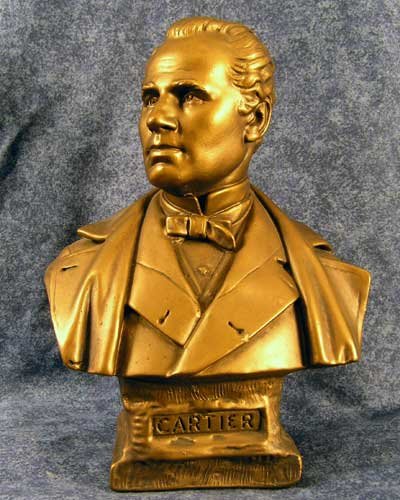
Sir Georges Etiènne Cartier by Philippe Hébert |
Orig. plaster bust - Size - 28 cm
Found - Ottawa, ON
|

Philippe sculpted hundreds of busts, most of famous people.
Some, like the pair above, of Macdonald and Cartier, were intended for fireplace mantles in gentile homes. The pair are out of plaster, and then painted with the popular antique gilt paint of the day. Probably it resonated with Catholics who had so much of their church statuary and carving coated with the same faux gold leaf.
Philippe also also crafted many busts, figures, and medallions, to adorn the tombstones for the wealthy classes in Quebec. These were often of bronze and were fixed to stone bases or monuments.
It is a terrible sign of the times that these stone and bronze busts have been chopped free, and stolen, often to sell to modern upper class collectors who have more money than ethics.
In the last couple of years scores of Philippe's busts, figures, and medallions have been stolen from cemeteries in Montreal. An entire website is devoted to showing before and after pictures of the tombstones that have been vandalized and desecrated, just to fill alcoves in houses in Westmount and other places where the wealthy gather their loot.




 Sir Charles Tupper 1821-1915: An absolutely priceless and rare statue of Canadian Prime Minister Sir Charles Tupper by Louis-Philippe Hébert, Canada's finest sculptor. Only once in a lifetime - if you are lucky - will you ever see a copy of this marvellous work, of the man destined to have the shortest term in office, only from May to July 1896.