



 Great Canadian Heritage Treasure Great Canadian Heritage Treasure |
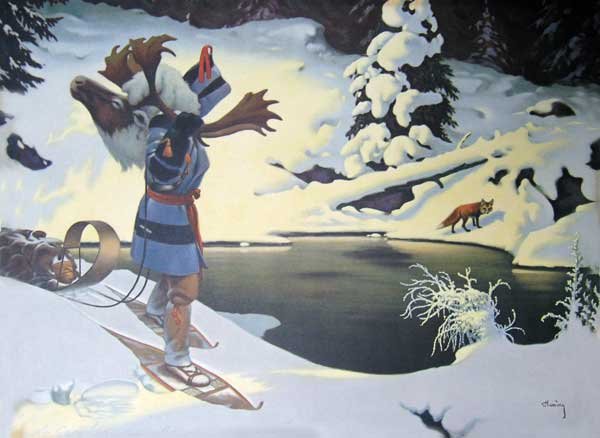 |
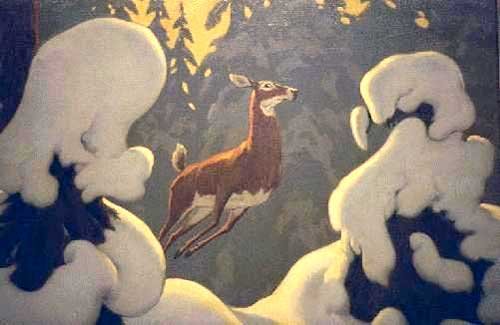
The Caribou Hunter, Arthur Heming, 1938 |
Orig. print - Size - 30 x 41 cms Found - Jordan Station, ON |
Arthur Heming at his best towards the end of his life. This is typical of Arthur's masterful style of painting, combining his skills as an artist, and his detailed knowledge of the animals and people of the Canadian wilderness, to create canvases in a way that no other Canadian artist could match. |

Faux Art
Here Art is putting one on, to suit the required conventions of the time for a photo. More than any painter of his generation Art Heming did not paint in a suit or indoors. He was the wilderness painter and traveler extraordinaire and the most exuberant en plein air artist of his day and probably ours as well, adventuring into distant parts of Canada when travel was long and arduous at the best of times, unlike in our day when Tony Onley flies to a BC glacier for a day and sleeps in Vancouver that night...
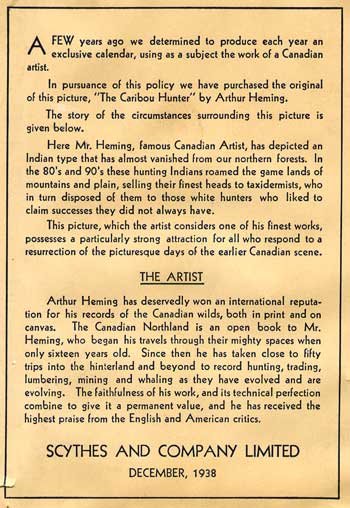
Arthur Heming's images, like the Caribou Hunter, were used on calendars or issued as prints to hang proudly in Canadian homes, like this one was, for the last 70 years, in Jordan Station, Ontario.
The label on the back, from 1938, tells the whole story.
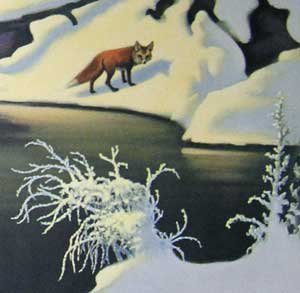
Anyone who has encountered a fox in the wilderness knows that Arthur has captured the fox perfectly, in that moment of recognition just after discovery, when the hunter has silently come up and surprised him in a world where he thought he was alone. Hunter and hunted know that next time, perhaps, they will meet under less friendly circumstances.
It would be false to portray Arthur Heming as a romantic with a rosy view of the wilderness where all was love and light. The cut-off caribou head make it clear he reflects a more hard-nosed age of wilderness usage, from a time long before the fine but cutesy wildlife images of Robert Bateman became popular. And anyone who has seen dead caribou can tell that Arthur has seen many, and captured the look exactly. What would Robert Bateman do with a dead caribou?... Exactly...
Arthur was too experienced in the wilderness to see it for anything other than what it was, a tough and merciless environment where only the smartest and toughest - like the Caribou Hunter - survive.
Arthur did not regard the society of man as any better than that of the wildlife kingdom. The caribou head, is after all, a cottage industry based on pillaging wildlife solely to be used as a false trophy by some rich white man to brag to friends and colleagues about the time he tracked, cornered, and killed a wily caribou, after hours on snowshoes in the Far North. We've all met this Canadian type in his urban haunts...
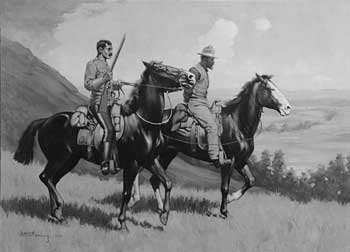
Arthur Heming's books - like The Living Forest - also features men who murder easily, and often, out of greed for money. (Right, the Cattle Thief). So we can assume that Heming did not really see either society as superior to the other.
Man and wildlife lived in uneasy community together. In the Caribou Hunter and Cattle Thief, Heming reminded those who pomposited about the superiority of civilization over wilderness.
Amazingly enough, Heming worked only in monochrome until 1930, because he had been informed early in life that he was colour blind. Heming was born in Paris, Ontario, and started making wilderness trips - and drawing what he saw - from the age of 16. He sent his work to US magazines who instantly recognized his talent and started using his art. Because of his passion for the Great Canadian Wilderness, Heming was to gain world renown as the "chronicler of the Canadian North," through his highly stylized and dramatically presented paintings, sketches, and books, featuring the people, places, and animals of the Canadian remote outdoors. He further developed his skills by taking art studies in New York and London.
In 1930, at the age of 60, he learned that he was not colour blind at all and set out to produce the marvelous romantic paintings for which he is rightly so famous. Sadly, he had only ten years left, but his brightly coloured canvases from that period, are ablaze with atmospheric light that few painters could match, and imbue their subjects with his highly romantic image of the North. Heming is most identified with his striking images of life in the Canadian North, where he traveled a great deal to absorb the scenery, and the atmosphere, with which he imbued his stunning canvases.
Heming was a famous author of adventure books on the North, as well, publishing Spirit Lake in 1907, The Drama of the Forest in 1921, and The Living Forest in 1925. He illustrated them with his fabulous paintings (Above, his fabulous York Boat). His paintings, along with those of CW Jefferys, AH Hider, and JD Kelly, have done more than those of any other Canadian painters to excite the imagination of countless generations of Canadian school children and imbue them with a lifelong passion for the romance of the people and places of Canadian history. Because he used his paintings to illustrate his books and because he wanted to tell stories with his paintings, art snobs referred to him as merely a lowly "illustrator" not a "real painter." One could just as easily say that a painter is often "one who has nothing to say, and does it badly, but justifies it by calling it art." (Oh, you mustn't forget he has to have a good agent. In fact, it is more important that the agent have talent - and be well paid - than the artist...) It is, lamentably, a continuing problem for our finest artists in our own day...
Probably Heming's accomplishments as an internationally recognized writer - proving that unlike most artists he was not merely a dabbler in paint - did not help endear him to the urban snobberati classes who set the tone for what is "good art" and "approved artists" in every generation. Heming was an early associate of the Group of Seven, and a member of the Arts and Letters Club, Toronto. Toronto Telegram critic Kenneth Wells described Heming's paintings as truly expressive of the Canadian north:
Above, In Canada's Fairyland, 1930 |
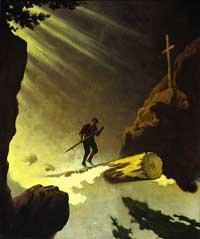 Colour-blind! Arthur Heming was one of Canada's most marvelous painters and developed a style so uniquely imbued with light and atmosphere, that anyone can spot his paintings from across the room, and confuse them with no other painter. (Right is a quintessential Heming painting of a logger descending a foaming torrent.)
 Somewhere, while he was young, he was informed that he was colour blind! Fearing ridicule if he chose an improper colour, or a clashing palate, he decided to work exclusively in black, yellow, and white, doing so for the next 40 years of his life.
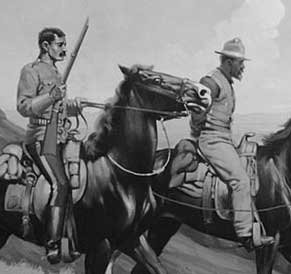 He traveled to the Canadian barren lands, and patrolled with the Royal Northwest Mounted Police in the mountains. (Left, the Cattle Thief, detail.) He logged some 550 miles by raft, 1000 miles by dog team, some 1700 miles by snowshoes, and 3300 miles by canoe.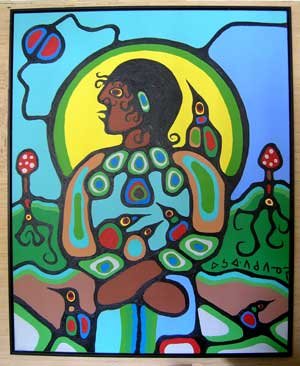
 Left is Canada's most famous - rather infamous - example of snoberati extremism, the Voice of Fire, acquired by the National Gallery of Canada in 1989, by spending $1.7 million dollars of hard-earned Canadian taxpayer's money on three vertical stripes by an American with no imagination, but with a good agent - who got a good commission for pulling it off.
 Right are two Canadian masterpieces by Norval Morrisseau, by far, Canada's most famous and influential Aboriginal painter. The National Gallery of Canada never spent a single dollar to acquire even the tiniest canvas from this masterful artist during his painting lifetime. Not one!
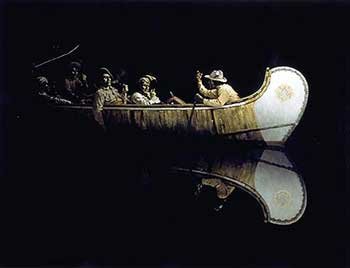 Write On! Now, let me see... which one could a school child copy in five minutes - so even an art snob couldn't tell the difference - the almighty American Voice, or one of the Morrisseaus above, or the Canadian Voyageurs, c 1905, by Heming right?
  "There is more of the north in them, more real Canadianism, as the landscape painters understand it, than in the whole lumped output of the Group of Seven. His pictures may not appeal to the sophisticates of the studio...Gallery curators may not find them satisfying to that snobbism which breeds in such places...In a modernistic wilderness of self-expression he puts self aside to accurately describe on canvas the life of a northland that is passing and that will soon be only a dream...he paints the north not as a painter loving colour and design for its own sake, but as an artist loving it for his subject's sake."