 Great Canadian Heritage Treasure Great Canadian Heritage Treasure |
Sure it's tiny but the image and story it tells - two small town Canadian military heroes, killed in action - is priceless and rare. We have not seen a similar one and we have seen thousands... In the 1890s to c 1920 an an enormous amount of small china souvenir ware was produced for sale in Canada, as the expansion of the railways, and road, and steam travel, took thousands of mostly urban Canadians on sight seeing trips that were unheard of only a generation before. |
 |
|
| Souvenir China, Soldier's Monument, Charlottetown, PEI - 1900 | |
| Orig. creamer - Size - 6.5 cm Found - St. John's, NF |
Copyright Goldi Productions Ltd. 1996-1999-2005 |
 |
Small Town Heroes - Charlottetown, PEI |


Of all china souvenir ware, creamers are the most common because they must have been popular being able to serve a useful function back home at the supper (southwestern Ontarian for dinner) table.
 Creamers are the smallest of the pitchers. Large pitchers would be used to hold milk. Small creamers being used to hold cream.
Souvenir creamers were the smallest of the creamers, many admittedly being too small to be of use even on the kitchen table. This one is only 6.5 cms tall.
Simply a souvenir. But perfect for tucking into a small Victorian handbag or purse of even the most dainty damsel who wouldn't want to carry anything bulky back home.

This creamer is special, in the first place, because it features a seldom encountered image of Hamilton MacCarthy's Boer War Memorial in Charlottetown, Prince Edward Island, in Canada's maritime provinces.
 But it is ultra rare because it also features portraits of two local lads, Roland Taylor and Alfred Riggs, who went off to fight in the Boer War in 1899, and were killed at Paardeberg, one on the first day of the battle and one on the last.
Both lie today on the battlefield where they fell.
 Boer War memorials were sometimes featured on souvenir ware but we have never seen any which also featured portraits of local war heroes.
|

An earlier generation of more noble small town heroes, in Charlottetown and Prince Edward Island, put country before family, and played important political roles in the 19th century. Confederation - the setting up of an independent Canada - was hammered out there by Canada's leading politicians, in 1864, sometimes in Government House or Fanningbank, right which was built out of wood in the Georgian style in 1834.
Sitting down in front, during the Conference, is John A Macdonald, the first Prime Minister of Canada to be, and standing in front of him, his main partner in forging the Dominion of Canada, George-Étienne Cartier. Standing behind him in black beard and hair is the only Canadian federal politician ever assassinated - Thomas D'Arcy McGee, by an Irish Fenian sympathizer in 1868.


Most of the Confederation discussions actually took place in Province House above, the second oldest legislative building in Canada. It was built in 1843-47 out of dressed stone in the Georgian style.
In its shadow stands Hamilton MacCarthy's Boer War memorial to Roland and Alfred.
 Go to Small Town Canada Go to Small Town Canada |
When the Boer War came along, some 26 years after PEI joined Confederation, the island citizens were determined to play their role again and sent local boys to join the war effort in South Africa.

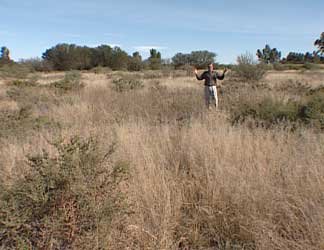
Above is the actual ground where the Canadians had their front line and where Alfred Riggs was killed facing the Boers behind us on Feb. 27.
Right Within sight of Paardeberg Hill, Canadian historian John Goldi advances in the footsteps of the Canadians, on the very ground where Roland Taylor was killed on Feb. 18, 1900, as they charged the Boers lying in trenches behind us.
This ground was littered with hundreds of dead, dying, and wounded British soldiers on a day forever remembered as Bloody Sunday. It was the worst day for British casualties of the entire Boer War.
Below how it was portrayed at the time in a celebrated Bacon print.
 Great Canadian Heritage Treasure Great Canadian Heritage Treasure |
|
 |
|
| Bacon Print, Dashing Advance of the Canadians at Paardeberg, Feb. 28, 1900 | |
| Orig. chromolithograph - Image Size - 56 x 76 cm Found - Montreal, QC |
| Go to Paardeberg |


 Probably the most fabulous Canadian commemorative souvenir china ever produced for sale in Canada.