



 Francis T Thomas of Quebec started a china importing business in 1874.
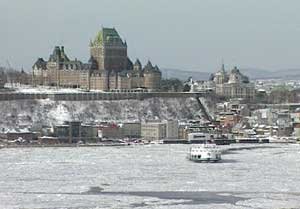 It can also be considered the location of the birthplace of Canada - the exact spot where permanent settlement by French colonists took place with the establishment of Champlain's Habitation, in 1608, where the church Notre Dame des Victoires is located on the extreme right of the picture above. Louis Hébert's historic farm - Louis is considered Canada's first, make that cash crop, farmer - was located to the left of the steepled building at the far top left. In time the Chateaux of the French Governors of Canada were built just to the left of the far end of the promenade, complete with the Governor's Garden, in which you can still follow in the footsteps where Frontenac once walked in the 1600s (the woods to the left of the hotel left). The site was razed, in the 1890s, to put up the Chateau Frontenac, Canada's most famous hotel, on Canada's most historic site, offering the finest hotel view of any in Canada.


 Where has one ever seen a more fabulous or huge Canadiana pitcher than this amazingly rare example from FT Thomas?
 Great Canadian Heritage Treasure Great Canadian Heritage Treasure |
It was invented in 1838 by Sir Charles Wheatstone, the same British professor who invented the concertina. It was based on the principle of human vision, which sees depth because two eyes, slightly offset, see the same picture from different angles so the brain combines them into a 3 dimensional view. The camera therefore used two lenses, slightly apart to take two nearly identical pictures, letting you see any view in three dimensions when placed in a viewer. The operator holds the viewer with the handle and places the stereoview in the clips on the rack which is moveable, in and out to allow the viewer to adjust it for his/her eyes. The wooden partition between the two eye ports is to ensure that each eye only sees the picture on its side, or the 3 D effect would be lost. |
| Stereo Viewer c 1880 | |
| Orig. stereo viewer - Image Size - 23 cm Found - Burlington, ON |
|
"Oh, goodie! A ViewMaster!" - Valerie Pringle It is patently not a 1950s ViewMaster, which the unfortunately irrepressible Canadian Antiques Roadshow Host, Valerie Pringle, called it, as she demonstrated an antique Stereoscope Viewer above to her audience, most of whom knew better. But then it's only one of many gaffes which have made Canadian antique collectors wince with embarrassment since this host started her job saying that she was never interested in antiques before someone offered her a paid gig... Since then she's proved over and over she meant what she said - this time not being able to tell the difference between a genuine wooden antique from 1850 and a plastic kitsch item from the 1950s... PS - She did it the same week her publicist arranged to have her infested with the Order of Canada. |
|
| Great Canadian Heritage Treasure |
| Stereoscope View - Quebec Canada, Natural Steps, QC - LM Vallee c 1880 |
| Orig. stereoscope - Size - 30 x 40 cm Found - Halifax, NS |
The label on the back of the stereoview also marks an interesting departure for professional photographers. They had been doing portrait work for years, even hand painting them to make them more attractive to buyers. With the spread of railway tracks and better roads across eastern Canada, after 1850, landscapes were easier to get access to than in the past. And after cutting down all the trees Canadians wanted a respite from staring at acres of stumps.. Tourists now wanted to see the sights they had heard about, and those that went wanted to bring back a memento to show off to friends back home. How about a nice stereoview of those fabulous "Natural Steps" at Quebec? |
|
Lord Dufferin (Governor-General of Canada, 1872-1878) campaigned to restore and protect the gates - which businessmen, never ones to let cemeteries or heritage buildings get in the way of progress, wanted to remove to trim maintenance costs and facilitate traffic flow. Most were torn down; four were rebuilt as glorified arches, for passing wagons, trams, then cars.
 Today, arches like the famous, Porte St.-Louis (St. Louis Gate) are still used to go in and out of Old Quebec, the only completely walled city in North America, and a UNESCO World Heritage Site, whose charm is increased immeasurably because of the gates of the city.
You could actually get an entire dinner set all bearing the picture of the Porte St.-Louis left. Today, sets like that are impossible to find; single plates are much easier to come by, and were probably bought as souvenir items by those visiting Quebec at the end of the Victorian era.
The South African Memorial is just out of frame on the right..

