Great Canadian Heritage Treasure Great Canadian Heritage Treasure |
Autographs are, for many people, the ultimate in antique collecting, because they give a close personal and emotional link to an actual person who played a major role in some historical event. This letter, on heavy, folded stock, is at the top rung of the desirable list for many reasons: It was signed by Sir Wilfrid during the high point of his administration, the longest unbroken run by any Canadian Prime Minister, from 1896 to 1911. The letter is entirely written by him, and then signed - not just a note by a secretary to which he merely added a signature. It is written, not on ordinary paper, but on stationary specially printed for the Prime Minister's Office and so stamped. It also refers to government business - not some trivial personal matter - with Sir Wilfrid requesting "Dear Sir Ménard, if convenient, I would like to have the members of the Sub-Committee to meet me tomorrow at 11:30 a.m." |
 |
|
| Signed Letter, Sir Wilfrid Laurier - 1906 | |
| Orig. letter - Written Page Size - 13 x 20 cm Found - Waterloo, ON |
| Great Canadian Heritage Treasure |
The honouree gets a certificate left, announcing his membership, as well as a badge. FAKE - FAKE - FAKE
For many collectors royalty signatures are the high point of autograph collecting, because..., well..., with some - well actually many - unfortunate lapses, they sleep with a better class of people... |
|
 |
||
| Capt. Walter Hughes, MBE | ||
| Orig. document - Image Size - 31 x 38 cm Found - Stratford, ON Autographed by King George VI and Queen Mary |
| Great Canadian Heritage Treasure |
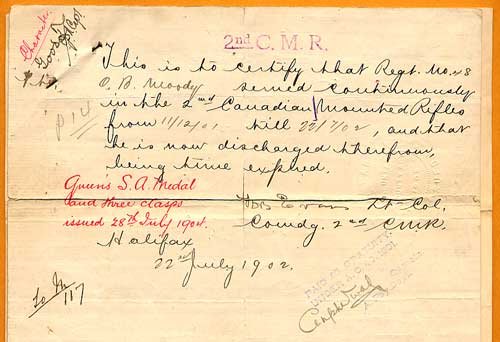
Evans went with two contingents to South Africa, the second time as the Commanding Officer.
Evans notes Otto's Character as "Good" and has signed it again on the back. Otto's signature is missing but it's on many of the things he used in South Africa.
|
|
 |
||
| Signed Discharge Papers, for Otto Moody - 1902 | ||
Orig. document - Size - 13 x 19 cm
|
| Great Canadian Heritage Treasure |
It bears the signature of D'Arcy Boulton, who would go on to build the Grange above one of Toronto's finest historic buildings, in 1817, for his wife Sarah below.
|
 |
|
| Signed Upper Canada Land Deed, Sir Francis Gore, 1809 | |
| Orig. deed - Size - 32 x 44 cm Found - Toronto, ON |
|
It also bears the signature of Sir Francis Gore, Lt. Governor - the Chief Administrator - of the Province of Upper Canada from 1806 to 1811, and 1814 to 1817. He played a big role in promoting self government in the province, by causing a local uproar when he closed down the Legislative Assembly because it refused to approve his ban on selling land to American refugees who were fleeing the US after the War of 1812. Upper Canada was full of American refugees who had shown their loyalty to Britain by fleeing the US in the 1780s, after the revolting Americans had their War of Independence.
|
| Great Canadian Heritage Treasure |
Among the most coveted letters are those from soldiers on the front lines, written in the midst of a military campaign. Such is this fabulous letter, written by young Otto Moody to his Mom, from South Africa during the Boer War in 1902. it gives the folks back home great detail about his adventures as a 19 year old as the Canadians chased the Boers in the western Transvaal in the bitter closing months of the war.
This letter one of about 20 Otto wrote after he signed up and details his life as a Canadian trooper in training, aboard ship, and in the field, until he returned home. Especially fine is that all envelopes in which the letters were sent are also present.
|
|
 |
||
| Boer War Letter, Canadian Trooper Otto Moody - 1902 | ||
| Orig. letter - Size - 13 x 17 cm Found - Wibaux, MT |
| Great Canadian Heritage Treasure |
The Last Letter Home One of the most poignant letters to find is one written by a soldier just before he dies at the front. Such a letter is this last surviving envelope of Trooper Curphy from Grimsby, Ontario. He signed it on the back. Months later he died of enteric fever, April 18, 1900, at Bloemfontein, after drinking Chateau Modder during the Battle of Paardeberg.
|
|
|
||
| Last Letter Home, Pvt. Curphy, RCR - 1900 | ||
| Orig. envelope - Size - 9 x 14 cm Found - Pasadena, CA |
| theCanadaSite.com |
| Copyright Goldi Productions Ltd. - 1996, 1999, 2005 |
| Great Canadian Heritage Treasure |
A very fine item, a letter written and signed by the Duke of Wellington, just three years after his fabled victory over Napoleon at Waterloo. For over a century it has been sealed in a hinged frame to allow one to take it out and feel the page the Duke's hand touched, two hundred years ago.
|
 |
|
| Signed Letter, Duke of Wellington, 1818 | |
| Orig. letter - Size - 11 x 18 cm unfolded Found - Toronto, ON |
|
Sadly, however prized his letter is, it is, like many others that become available from great historical figures, about boring household chores. It is not about fighting at the front, or written from his battlefield. The most prized letters are ones written in the throes of the work for which he or she is famous. At about the same time the Duke was worrying about his digs, so were many of his former soldiers. Now that Boney was defeated and isolated on St. Helena, Britain had a huge problem of tens of thousands of unemployed soldiers and officers, of whom many moved to Canada, to hack out a home in the wilderness there. And start to name towns, streets, squares after their hero: Arthur Wellesley, Duke of Wellington. Today each of his names - Arthur, Wellesley, Duke, Wellington - are liberally sprinkled across southern Ontario. |
|
| Great Canadian Heritage Treasure |
|
|
 |
||
| Signed Dinner Menu, General Buller - 1900 | ||
| Orig. menu - Size - 14 x 16 cm Found - Boulder, CO |
| Great Canadian Heritage Treasure |

A fabulous memorabilia program, personally signed by James McKerihen, of a service held in Westminster Abbey, in London, UK, on Dec. 2, 1900, to thank the Royal Canadian Regiment, Canada's First Boer War Contingent, on its return home from the wars. (On the way back to Canada it stopped in London, UK, after its one year service contract time was over.) The booklet, which contains an opening prayer, an eleven page sermon, and ends with a three verse version of God Save the Queen, is proudly signed, on the flyleaf, in James' elegant hand. He knew he was taking part in a historic event and he wanted to record that he had played his part. Like for so many veterans, the war would be the highlight of his life, taking him from a humdrum previous existence as a clerk and raising him to a platform of national importance which he would probably never achieve again. Like millions of other Canadians, in the 20th century, he put his life on the line for his Queen (King) and Country; he was one of the fortunate ones who returned...
|
|
 |
||
| Program, Sermon, Westminster Abbey - Dec. 2, 1900 - JRD Mckerihen | ||
| Orig. program - Size - 14 x 21 cm Found - Toronto, ON |
||

James kept his mementoes of his war against the Boers because he was proud of his involvement. In his sermon, the Archdeacon extolls pride of race. We know James' heart would have pounded. He knew he and his mates were fine specimens of the British race indeed... It would be wrong to call James a bigot and racist; he didn't know any better. He was a man of his time, as were the Boers he was fighting. Everyone was full of racial pride in the nineteenth century, each ethnic group believing they were the superior incarnation of Man in God's Universe. The Germans under Kaiser Wilhelm were equally proud of their race. As were the Boers. Today modern people no longer believe race based societies are the answer; racism has led to the worst human depredations in modern history.Today people no longer openly promote racial favouritism; it has gone underground. Racism is denounced around the world by virtually everyone; to form a racist group for political action should be anathema to the world of civilized men. But then white men have never let their claim to civilized status stand in the way of their depredations in the Third World.
|
||
| Great Canadian Heritage Treasure |
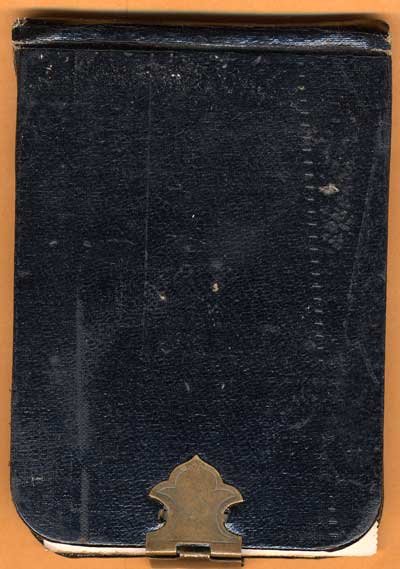
Among the very best autograph documents are the diaries or working books of soldiers in the field. This diary of William Stokes of Fingal, Ontario lists the names of all his chums, their addresses, and notes whether they were wounded or killed.
|
|
 |
||
| Boer War Diary, Bill Stokes, RCR - 1899 | ||
| Orig. diary - Size - 9 x 15 cm closed Found - St Thomas, ON |
||
|
||
| Great Canadian Heritage Treasure |
Many of the Canadian boys stayed on as policemen after the war ended, Whitfield until 1905, confirmed by his menu and ticket aboard the Kinfaun Castle on October 28, 1905. SAC Commander Sam Steele also stayed till 1906. The diary is signed three times in full by Whitfield and with initials. Clearly he was trying out a professional looking signature for such a young boy doing such earnest business in a theatre of war. He itemizes numerous patrol routes, listing several hundred farms and their owners, the brands of missing cattle and sheep he's looking for. He also has a one page description of a felon wanted for fraud. A highly rare collection of dozens of photos, other documents, and many pages of diary entries that provide an unprecedented look at the work of a Canadian trooper doing policing with the South African Constabulary during and after the Boer War. |
 |
|
| Diary, W Millard, South African Constabulary - 1904 | |
| Orig. diary - Size - 23 cm Found - Edmonton, AB |
|
  |
|
 |
|
Above is #1 Squad of 19 Troop, SAC.
|
|


Right is the spot where Major Benson's night march ended, at dawn, as Boer riflemen hiden in trenches, ambushed the unsuspecting Tommies. Scores of them lie buried under the monument.
 Go to Major Benson's Disaster Go to Major Benson's Disaster |
| Great Canadian Heritage Treasure |
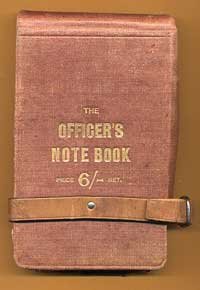
One of the most fabulous working books, of a major soldier in combat operations, has to be Major Benson's 1899 field notebook, signed in his own hand, which has detailed notes on "Night Operations" and "Night Marches."
It was Major Benson, with his comass, who led the night march of the Highland Brigade at Magersfontein in December 1899, which became one of three celebrated disasters that befell British arms during "Black Week." |
 |
|
| Signed Notebook, Major GE Benson RA - 1899 | |
| Orig. book - Size - 12 x 17 cm Found - Birmingham, UK |
| Great Canadian Heritage Treasure |
Right is how the Canadians, and the British - since this is a British Manual for the fighting Tommy of 1896 - were going to stand against the mounted Boer farmers.. The horrific reverses suffered by the British in the opening months of the war showed how useless much of what was written in the manual was. The Boers were hardly deterred by bristling bayonets, preferring to leisurely pot them down from a mile away.
|
|
 |
||
| Signed Drill Manual, Sgt. Robert Marshall, 22nd Regt - 1896 | ||
| Orig. drill manual - Size - 9 x 12 cm Found - Burlington, ON |
| Great Canadian Heritage Treasure |
|||
 |
|||
| Postcard, Commandant JP (Koos) Jooste - 1901 | |||
| Orig. pc - Size - 9 x 14 cm Found - Berlin, GDR |
|||
What was sold as a typical anonymous postcard, of Boer Commandant JP Jooste, was, we discovered, upon closer examination, to be a personal greeting and autograph, written by JP himself to an admirer, on a card which featured his (printed) cameo portrait and autograph. The person who wrote the address on the obverse, is the same hand that penned the message on the front of the card, and signed it JP Jooste, in exactly the same way as Jooste's autograph is printed under his photograph as part of the original card.
The postcard says - in German - that this card is a greeting from a German Boer Supporter Assembly and that the net proceeds, raised from the sale of this card would go - without deductions - towards the All German Boer Congress.
|
| Great Canadian Heritage Treasure |
It was 1943; the world was in the midst of a terrific and devastating war that was killing millions. Canadian civilians, by the hundred thousands, like Joe Barfoot left signed up for duty overseas. When war broke out he had lived in North Toronto. When he signed up for the Air Force, being a civilian, he needed training, which had to take place far from Toronto, where he had developed a relationship with Audrey Mackenzie, a nurse who hailed from a farm near Erin, Ontario. But besides the war in Europe, another was brewing in Toronto. Parents Olive and Joe (senior), in the 1960s, in good middle class gentility, with her serving him, the sole bread winner, while she keeps the social calendar hopping, with dinners and teas with all the best people... It seems they were not too keen on the nurse... His son wrote directly to his father, not "to Mom and Dad."
|
|
 |
||
| War-time Letter, Joe Barfoot, 1943 | ||
| Orig. letter - Size - 13 x 20 cm Found - Toronto, ON |
||
|
||




 Here, on Canadian trooper Otto Moody's discharge papers is the signature of one of Canada's leading figures of the Boer War, Col TDB Evans




 A truly fabulous diary, and photos of Trooper Whitfield Millard, who served as a police officer with the South African Constabulary, formed by General Baden-Powell - of Boy Scout fame - to patrol the territories the British took over during the Boer War.