Great Canadian Heritage Treasure Great Canadian Heritage Treasure |
The Officer's Note Book was was carried in the field by British officers and supplied them with all kinds of handy battlefield information.
The Signature: Of special interest is the signature of an officer which appears inside the title page, made the year after the book was published. Major Benson led the night march, with his compass, to the disastrous British defeat at Magersfontein. He died heroically later in the war, as one of Lord Kitchener's most successful generals. |
||
|
|||
| Note book of Maj. GE Benson RA, 1899 | |||
Original Book - Size - 4.5" x 6.5" |
|||
The exact spot where Major Benson's night march ended, prematurely, when the unsuspecting British were ambushed as they were attempting to sneak up, in a dawn attack, on the Boers on top of Magersfontein hill in the background. Scores were killed including Major-General Wauchope of the Highland Brigade.
|
|||
An item like this is valuable because, since it bears a soldier's signature below on the leather sweatband, and on the chin strap, we can confirm the materials, construction of the equipment and uniforms that were issued to the troops, and use it as a standard for rejecting bogus items that militaria dealers try to sell, deceptively, as "real Boer War items."


 Go to James' signed helmet Go to James' signed helmet |
| Great Canadian Heritage Treasure |
Signed souvenir "captures" are fabulously rare to find as is this fine example of war booty "liberated" by JRD McKerihen, and autographed by him in great detail on the war front in South Africa in 1900.
|
|
 |
||
| Signed Souvenir Boer Staats Artillerie Belt, Pvt. JRD McKerihen, C Co, RCR - South Africa 1900 |
||
| Orig. leather - Size - oa Found - Toronto, ON |
| Great Canadian Heritage Treasure |
Genuine Canadian Boer War pith helmets, in any condition, are extremely rare to find, especially named ones, which this one, with two signatures, is. This one is especially important because it is in fine shape and complete in all respects: - it is named to Pvt. James Reid Dill McKerihen of C Co. RCR - it comes with its original khaki cover, provided to camouflage its original white material - its original CANADA badge - its original leather chin strap - signed - its interior leather sweatband - signed - with cork spacer - its original vent cap It is the helmet that James wore on the March to Pretoria, and during the Battles of Zand River and Doordrecht. It is also the helmet he wore to the RCR Farewell Service, in Westminster Abbey, and waved in the air when Queen Victoria came to bid the RCRs farewell at Windsor Castle, one of her last public appearances before she died a few weeks later. This helmet gazed on Queen Victoria. |
 |
|
| Pith Helmet & Cover, Pvt. JRD McKerihen, C Co, RCR - South Africa 1900 | |
| Orig. pith helmet - Size - 21 x 37 cm Found - Toronto, ON Prov - McKerihen Coll |
| Great Canadian Heritage Treasure |
 |
| Signed Boer War Duffle bag, FM Little, 2 CMR - 1902 |
| Orig. canvas - Size - 39 X 59 cm Found - Wibaux, MT |
Among Otto's effects was this second duffle bag signed by FM Little, Trooper #196, a 2nd CMR chum who hailed from London, Ontario. No doubt these bags overheard many conversations between the pals as they packed and unpacked their bags on campaign. |
| Great Canadian Heritage Treasure |
 |
| Signed Boer War Duffle bag, Otto Moody, 2 CMR - 1902 |
| Orig. canvas - Size - 39 X 59 cm Found - Wibaux, MT |
Otto was taking no chances on having it stolen; he signed it boldly on two sides, as well as the bottom. But one suspects this brash signature was also part of the growing up ritual of a young boy of 18, wanting to identify himself as a fully grown partner, among military men embarking on a dangerous mission. This duffle bag has seen it all: was in the hold of the Milwaukee, the train from Cape Town to the front, and on who knows how many wagons; accompanied the Canadian Mounted Rifles as they chased Generals Koos de la Rey, and President Steyn across the Western Transvaal. This bag is surprisingly small, about half the size of duffle bags issued in later wars. The signature allows a benchmark that helps identify other duffle bags from the period, which have no signatures. |
| Great Canadian Heritage Treasure |
Because this is tied to an actual person, time and place, this belt has an emotional wallop you can get in no other way. It is stamped trooper # 48, D Squadron, Canadian Mounted Rifles, ie Otto Moody. There are countless belts of this vintage that are unstamped and could be from anywhere or more likely - lacking identifiable provenance - nowhere. As personal memorabilia they have little value. |
 |
|
| Signed Boer War Belt, Otto Moody 2 CMR - 1902 | |
| Orig. leather - Size - 1m 6 cm Found - Wibaux, MT |
| Great Canadian Heritage Treasure |
It is from Otto's 2nd Canadian Mounted Rifles regiment and marked as belonging to his own D troop, but from the 3rd Squadron. Kit tended to wander. This strap was a highly unique creation used specifically for wrapping around the leather wallets that were strapped at the front of the saddle.
|
|
 |
||
| Signed Boer War Saddle Wallet Strap, Otto Moody 2 CMR - 1902 | ||
| Orig. leather - Size - cm Found - Wibaux, MT |
| Great Canadian Heritage Treasure |
But better than that they are stamped with his D troop letter on one of the straps. They are the only spurs signed to a trooper we have ever come across, though we have unsigned spurs with attribution provenance to other cavalrymen. Otto's experiences with horses are documented in his letters home to his sister, as he tells of how his first horse was stolen, and the joke played on him by his CMR mates who eagerly supplied him with a new one - it turned out to be a bucking bronco, which threw him repeatedly to the hearty laughter of his colleagues. |
 |
|
| Signed Boer War Spurs, Otto Moody 2 CMR - 1902 | |
| Orig. spurs - Size - 23 cm Found - Wibaux, MT |
| Great Canadian Heritage Treasure |
The signature means it was on campaign with its owner and not just some militaria stores item that never went anywhere. This haversack saw action with Otto and his regiment in the Boer War in 1902.
|
 |
|
| Signed Boer War Knapsack, Otto Moody, 2 CMR - 1902 | |
| Orig. cotton - Size - cm Found - Wibaux, MT |
| Great Canadian Heritage Treasure |
Signed binoculars come in several levels, with this stamped pair being among the most fabulous to find. The inscribed signature of the North West Mounted Police, on the barrels, is rare to find, placing this pair into the period from 1873 to 1904.
Left near Farwell's whiskey trader's fort left the lonely field where dozens of Assiniboine men, women, and children were massacred, resulting in the creation of Canada's national police force in 1873.
|
|
 |
||
| Field Glasses, NWMP - 1870S | ||
| Binoculars - Size - 8" to 8.75" Found - Toronto, ON Mint condition with orig. leather covering intact |
||
 |
||
| Great Canadian Heritage Treasure |
These glasses were sold by someone who could not exactly decipher the inked signature, couldn't reference the name, and never discovered the stamp on the leather (which is very faint and hard to make out unless one is looking with a loupe.)
Good knowledge and sleuthing proved this to be a fantastic find belonging to a major soldier. A personal stamping on binoculars or strap is a higher level of signature on binoculars. Fred probably had the camp shoeing smith stamp the strap for him to prevent theft.
|
|
 |
||
| Field Glasses of Maj. FM Burnham - 1900 | ||
| Binoculars - Size - 8" x 12" fully extended Found - London, UK |
||
| There are many anonymous binoculars that look old out there, but without a unique stamping, a date, or a certifiable personal signature, you have no way of proving that they were not simply recreational hunting glasses that never went on any military campaign. | ||
| Great Canadian Heritage Treasure |
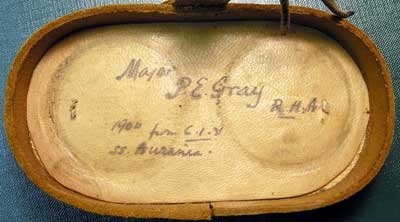
A fabulous find are the binoculars of Boer War Major PE Gray of the Royal Horse Artillery, in their original signed case. The personally signed binoculars are the highest level of signature you can get. This signature even provides time and place, with the CIV aboard the liner Aurania. Shipping records confirm Gray aboard Aurania with that contingent.
Binoculars and telescopes played a bigger role in the Boer War than any previous war in history. Cordite to fire artillery shells thousands of yards, and high-powered Mauser rifles, which could fire accurately to a mile, meant death-dealing danger now could be miles from you. Spotting the enemy at long distances had never been more important. For both sides. These glasses were probably taken from a dead Boer. Gone were the days when no one was dangerous unless they were within the visible spectrum: spear-throwing distance or cannon ball range.
|
|
 |
||
| Boer War Binoculars of Maj. PE Gray RHA - 1900 | ||
| Orig. binoculars - Size - 6" extended Found - Vancouver, BC Lid signed "Major PE Gray RHA, 1900 from CIV SS Aurania," barrels etched "C.I.V." and "JAM" |

Below AY Jackson's Gas Attack at Lieven, 1918
A. Y. Jackson wrote:
"I went with Augustus John one night to see a gas attack we made on the German lines.
It was like a wonderful display of fireworks, with our clouds of gas and the German flares and rockets of all colours."

The French Allies were the first to use gas in World War I.
Though the most feared weapon of World War I gas was more a psychological help than an effective killing tool.
The number of soldiers it killed are not even a blip on the carnage of butchery that occurred from other weapons.
During World War I gas the major gas fatalities included:
- Germany - 9,000
- British Empire - 8,100
- France - 8,000
- Russia - 56,000
| Great Canadian Heritage Treasure |
It makes a horrifically loud noise. |
|
 |
||
| Signed Canadian WWI Gas Rattle, JC Baker - 1917 | ||
| Orig. wood - Size - 29 cm Found - Cookstown, ON |
||
Poison gas was used by both sides in World War I as each tried to find the magic trick to give them the advantage to turn the stalemate on the Western Front to their advantage. Being gassed resulted in a horrific choking kind of death, so warning rattles soon became standard equipment, hoping to give anyone within hearing range time to get their gas masks on.
His original signature had faded by the time he redid it with a feeble hand later in life. It came from a family estate clearance.
|
||
| Great Canadian Heritage Treasure |
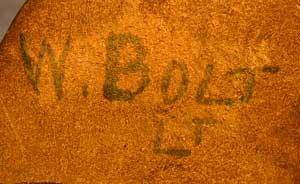
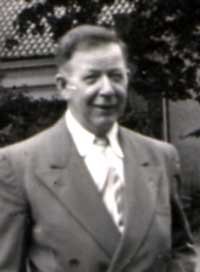
A fabulous signed compass used by Canadian Bill Bolt, on the Western Front, during World War I, when he served as a lieutenant. Signed items by themselves are fabulous. But when they are accompanied by a photo of the owner as well, it is beyond compare.
|
|
 |
||
| Signed WWI Compass, Lt. William Bolt, 1918 | ||
| Orig. compass - Image Size - 16 cm unfolded Found - Burlington, ON |
| Great Canadian Heritage Treasure |
A most fabulous discovery is the signed bugle of Canadian Mounted Rifles Trooper Edwin McCormick. It is stamped and dated 1901. It is one of the rare bugles to be hand inscribed by the owner. The two Boer names, from South Africa, are remote areas that Edwin's regiment, the CMR, was campaigning in early March 1902. At the Brackspruit it fought a major battle. The combination of: the regimental history, Edwin's history, the stamping, dating, place this squarely as a Canadian bugle that might have been used in the war in 1901 or 1902.
|
|
 |
||
| Boer War Bugle of Edwin McCormick - 1901 | ||
| Orig bugle - Size - 29 cm Found - Toronto, ON Signed C Mahillon & Co., 1901 |
| Great Canadian Heritage Treasure |
A fabulous bugle that is signed several ways as being a battlefield bugle. It is stamped by Henry Potter and dated 1916; it came directly from the family of Norman Pearson whose bugle it was during the Siberian adventures of the Canadian Army in World War I; it came with his dog tags. With so many unsigned and fake bugles being hawked by eager sellers than ever before, finding this one with all its powerful provenance, makes this a rarity in the bugle field of authentic memorabilia, and a fabulous memento of a unique part of Canada's role in World War I..
|
|
 |
||
| Norman Arthur Pearson's bugle, 1917 | ||
| Henry Potter - Size - 29 cm Found - Asheville, NC Signed Henry Potter 1916 , copper & brass with original patina, bugle cords, and dog tags, to Norman Pearson 67th Battery CFA |
| Great Canadian Heritage Treasure |
There are an enormous number of bugles out there that are not signed or stamped, but which eager sellers purport to be from this or that regiment or this or that war. Most are bogus. Bugles that are not signed of stamped have minimal value as historical memorabilia items because they lack a traceable record, to a regiment, a campaign, a battle, or a person. The bugles here show the kind of signature you should look for. Army and cavalry bugles were stamped, often with the military crowfoot, with the manufacturer's imprint, also the year, and sometimes, the regiment or a dedication. In very rare cases the owner scratched something personal on them, but this is seldom seen. To find a bugle with a Canadian imprint, such as this fine bugle has, is very rare. This RS Williams bugle from Toronto has the coveted C for Canada surrounding a military crowfoot. We have only seen two bugles marked this way in 10 years.
|
|
 |
||
| World War I Canadian Bugle - RS Williams Mfg, 1916 | ||
| Orig bugle - Size - 28 cm Found - Strathroy, ON Signed RS Williams & Sons Co. Ltd., Canadian broad arrow |
| Great Canadian Heritage Treasure |
Presentation bugles are a very special kind of memorabilia because they can be tied to real people and a real time and place, with through the inscription, makes the attribution to Dr Molloy of Blackpool right foolproof. The wear on this inscription shows it is as old as the bugle itself so not a later bogus addition by a cunning forger. And it does happen. UK police investigators from Liverpool enquired about any information we could provide regarding an offer we had made on a bugle with an inscription which we had backed out of, fearing it was bogus.
It turned out the buyer who bought it reached the same conclusion and so did the police after hearing our side. They went after the seller - a major UK memorabilia dealer - for fraud. This inscription is the real deal.
|
|
 |
||
| Boer War Presentation Bugle of Dr. L Molloy, 1901 | ||
| Orig. bugle - Size - 29 cm Found - London, UK |
| theCanadaSite.com |
| Copyright Goldi Productions Ltd. - 1996, 1999, 2005 |
| Great Canadian Heritage Treasure |
An amazing historical treasure, a busby hat box from the 1860s, bearing the battered WDO signature of William Dillon Otter, who would become Canada's first full-time professional soldier and the first Canadian-born commander to become top general of the Canadian Army.
|
|
 |
||
| Signed Busby Hat Box & Busby, William Dillon Otter, c 1862 | ||
| Orig. plate - Image Size - 23 cm Found - Eugene, OR |
| Great Canadian Heritage Treasure |
This numbered hoof belonged to a Victorian member of the North West Mounted Police. It probably died or was killed during police work on the prairies. It came from an estate in a lot that included NWMP badges, horse bits, and other memorabilia from a time when the Mounties were the only law and order on the western frontier.
|
|
 |
||
| Horse Hoof Souvenir, RNWMP - 1904 | ||
| Orig. horse hoof - Size - 19 cm Found - Toronto, ON |
| Great Canadian Heritage Treasure |
A fabulous signed horse's hoof inkwell from the Boer War It belonged to Capt. Harold Fielden DSO, member of a prominent Yorkshire family, who had his medal presented to him by King Edward VII, on Oct. 29, 1901. Many Victorian officers had inkwell memorabilia made of some favourite horse that was killed during their campaigning. For centuries the horse carried the fight to the enemy on the battlefield with either a cavalryman or a gunner riding them into the jaws of hell. Hence the close ties between a fighting man and a fighting horse sealed with a hoof memento of a partnership going back thousands of years. By the time World War I came along a dozen years later the horse as a fighting animal was a thing of the past. The horse had been reduced to a transport animal for pulling wagons and guns behind the lines. And even this task was being taken over by gasoline powered trucks. The horse was being withdrawn from modern battlefields. Now if we could only do the same with men...
|
|
 |
||
| Horse Hoof Inkwell, Requisition - 1901 | ||
| Orig. horse hoof inkwell - Size - 13 x 14 cm Found - Birmingham, UK |



 We are pleased to have discovered, and rescued from the trash heap of history, a most wonderful memento of a great Anglo-Boer War hero, Col. G.E. Benson RA.


 They already have tremendous provenance because they came with all his other signed equipment and letters.



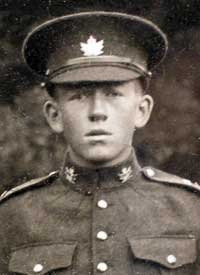
 JC Baker from Cookstown, Ontario, a World War I veteran who was lucky enough to return, kept his trench rattle as a souvenir of the most horrible time of his life. How many times did he use it as he saw gas drifting towards the lines?